

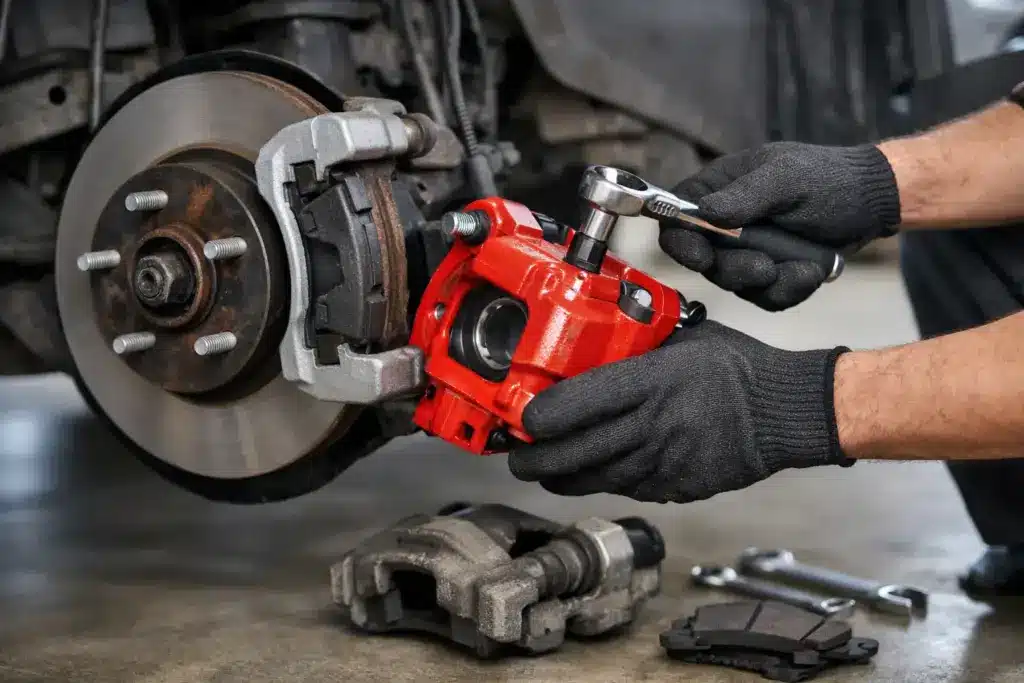
A brake caliper can fail quietly at first. Maybe the vehicle pulls a little when you stop, one wheel gets unusually hot after a short drive, or you notice a burning smell near the tire. Brake caliper replacement explained simply means finding out whether the part that squeezes your brake pads is still moving and holding pressure the way it should. When it isn’t, putting the repair off can wear out pads and rotors fast, hurt braking performance, and turn a manageable repair into a bigger one.
What a Brake Caliper Does
Each disc brake assembly has a rotor, brake pads, and a caliper. The rotor spins with the wheel. When you press the brake pedal, brake fluid pressure moves a piston or pistons inside the caliper. Those pistons press the pads against the rotor, creating the friction that slows the vehicle.
The caliper also has to release properly when you take your foot off the pedal. That part matters just as much as applying the brakes. A caliper that sticks can keep one pad rubbing the rotor all the time. On a Minnesota commute, that constant friction builds heat quickly and can damage parts that were otherwise still usable.
Some vehicles use floating calipers that slide on guide pins. Others use fixed calipers with pistons on both sides of the rotor. The design changes the repair details, but the goal is the same: smooth, even braking without dragging, pulling, noise, or overheating.
Signs a Caliper May Need Attention
Brake trouble doesn’t always mean the caliper needs replacement. Worn pads, a warped or heat-spotted rotor, seized slide pins, a restricted brake hose, or even a wheel bearing issue can create similar symptoms. That is why a proper inspection comes before ordering parts.
Common warning signs include:
- The vehicle pulls left or right while braking or while cruising.
- One wheel feels much hotter than the others after driving.
- You smell something burning or see smoke near a wheel.
- Brake pads on one side wear much faster than the other.
- The brake pedal feels different, the vehicle takes longer to stop, or braking feels uneven.
- You hear grinding, scraping, or a persistent squeal from one corner of the vehicle.
- Brake fluid is leaking around the caliper, hose connection, or bleeder screw.
A hot wheel deserves quick attention. Don’t spray it with cold water or keep driving to see if it clears up. Heat can ruin pads, damage the rotor, cook wheel-bearing grease, and in severe cases affect the tire. If you suspect a dragging brake, it’s safer to have it checked before the next long trip.
Brake Caliper Replacement Explained Step by Step
A quality caliper job is more than removing one part and bolting on another. First, the technician confirms the cause of the problem. They inspect pad thickness and wear patterns, rotor condition, caliper movement, guide pins, brake hose condition, fluid leaks, and the hardware that supports the pads.
If replacement is the right call, the vehicle is lifted safely and the wheel is removed. The old caliper comes off, the brake hose is disconnected carefully, and the mounting area is inspected. Depending on the vehicle and the condition of the brakes, the repair may also include new pads, rotors, hardware, guide-pin service, or a new hose.
The replacement caliper is mounted to the correct specifications, the brake line is connected, and fresh brake fluid is used to bleed air from the system. Bleeding is not a shortcut step. Air in a brake line can create a soft pedal and reduce braking confidence. The technician then checks for leaks, confirms proper brake operation, and road-tests the vehicle when appropriate.
It may sound straightforward, but details matter. The right caliper must match the vehicle’s side and brake configuration. Hardware needs to fit correctly. Brake fluid needs to stay clean. Mounting bolts require the correct torque. Those are the small things that separate a repair that merely looks finished from one that’s done right.
Should You Replace One Caliper or Both?
There isn’t one answer for every vehicle. If one caliper is leaking, seized, or clearly damaged, it has to be addressed. Whether the caliper on the other side should also be replaced depends on its age, condition, vehicle mileage, parts availability, and the overall brake inspection.
Brake pads and rotors are commonly serviced in pairs on the same axle because they work together and need balanced friction. Calipers are different. If the opposite caliper is operating correctly and isn’t corroded or leaking, replacing only the failed caliper can be reasonable. On an older vehicle with heavy corrosion or high mileage, replacing both may make more sense for long-term reliability.
The honest answer is that you should pay for the work your vehicle needs, not a package someone is trying to sell. At Joe’s ALL TIRE, we look at the whole brake system and explain what we found in plain language. ALL TIRE can tell you whether a single-caliper repair is sensible or whether related parts are likely to create another problem soon.
What Affects Brake Caliper Replacement Cost?
The cost can vary quite a bit. A front caliper on a common passenger vehicle is often a more straightforward job than a rear caliper with an integrated parking-brake mechanism. Trucks, performance vehicles, and vehicles with electronic parking brakes can require more labor or more expensive parts.
The final price usually depends on the caliper itself, labor time, brake fluid, and whether heat or uneven wear has damaged the pads and rotors. A dragging caliper caught early may only need a caliper and related service. One driven for weeks may leave behind a blue or cracked rotor, burnt pads, and additional damage.
Used parts aren’t a good choice for a brake caliper repair. A caliper’s condition isn’t always visible from the outside, and a part with internal corrosion or a damaged seal can fail again quickly. Quality replacement parts and careful installation protect the value of the repair.
When You Can Drive and When You Should Stop
A light brake squeal doesn’t automatically mean you need to park the vehicle. But certain symptoms should move the problem to the top of your list. If you smell burning, see smoke, feel a major pull, hear metal-on-metal grinding, notice a brake fluid leak, or have a soft pedal, don’t keep driving normally. Have the vehicle inspected or towed as the situation requires.
If you’re unsure whether the symptoms can wait, getting a direct answer is better than guessing. Mobile visitors can tap the blue call button in the lower left corner to ask questions or schedule an appointment. We’ll help you decide what makes sense for your vehicle and your safety.
How to Help Your New Caliper Last
A replacement caliper should provide years of dependable service, but the rest of the brake system still needs attention. Brake fluid absorbs moisture over time, especially through Minnesota temperature swings. Old fluid can contribute to internal corrosion in calipers, brake lines, and other hydraulic components.
Ask for brake inspections during tire rotations and routine service. Watch for uneven pad wear, and don’t ignore a pull, vibration, or new brake noise. If your vehicle sits for long stretches, drive it periodically when conditions allow, since moisture and corrosion are hard on brake parts that don’t move.
Good brake care isn’t about replacing parts early just because they’re old. It’s about inspecting them carefully, fixing the actual cause, and using parts and procedures that hold up after you leave the shop.
Frequently Asked Questions
Can a stuck brake caliper be repaired instead of replaced?
Sometimes. If the issue is a dry or seized guide pin, the caliper itself may be fine and the slide hardware can be serviced. If the piston is seized, the caliper is leaking, or internal corrosion is present, replacement is usually the more dependable repair.
How long does brake caliper replacement take?
Many single-caliper replacements can be completed in a few hours, but the timing depends on the vehicle, corrosion, parts availability, and whether pads, rotors, hoses, or other work are needed at the same time.
Will a bad caliper cause a check-engine light?
Usually not. A failing caliper is a mechanical and hydraulic brake problem, so it may not trigger a dashboard warning. Some vehicles can show brake or ABS warnings if another part of the braking system is involved.
Do I need new brake pads with a new caliper?
Not always, but it is common. A dragging caliper often creates uneven or heat-damaged pad wear. If the pads are contaminated, thin, glazed, or worn unevenly, replacing them is the right move.
Can a bad caliper damage a tire?
It can. Extreme heat from a dragging brake can transfer through the wheel and affect the tire, along with the rotor and wheel bearing. Any tire near an overheated brake should be inspected before you rely on it.
If your vehicle is pulling, running hot at one wheel, or simply doesn’t feel right when you brake, trust that instinct. A clear inspection now can keep a small brake issue from following you down the road.
