

That shaking in the steering wheel when you brake is where this question usually starts. A lot of drivers hear they need brake rotors and immediately wonder about rotor replacement vs resurfacing – and whether one option is smarter, safer, or just cheaper.
The honest answer is that it depends on the condition of the rotors, not just the price on the estimate. In some cases, resurfacing is a perfectly reasonable repair. In others, replacing the rotors is the only way to do the job right. At Joe’s All Tire, the goal is simple: give you the option that makes sense for your vehicle, your budget, and your safety, without pushing extra parts you do not need.
If your brakes are making noise, pulsing, or just do not feel right, it helps to talk it through before you approve the repair. If you want a straight answer on what your vehicle actually needs, just tap the blue phone call button in the lower left corner – we’re just a call away.
Rotor replacement vs resurfacing: what is the difference?
Brake rotors are the metal discs your brake pads squeeze to slow the vehicle. Over time, they wear down from heat, friction, and normal use. When pads are being replaced, the rotors often need attention too.
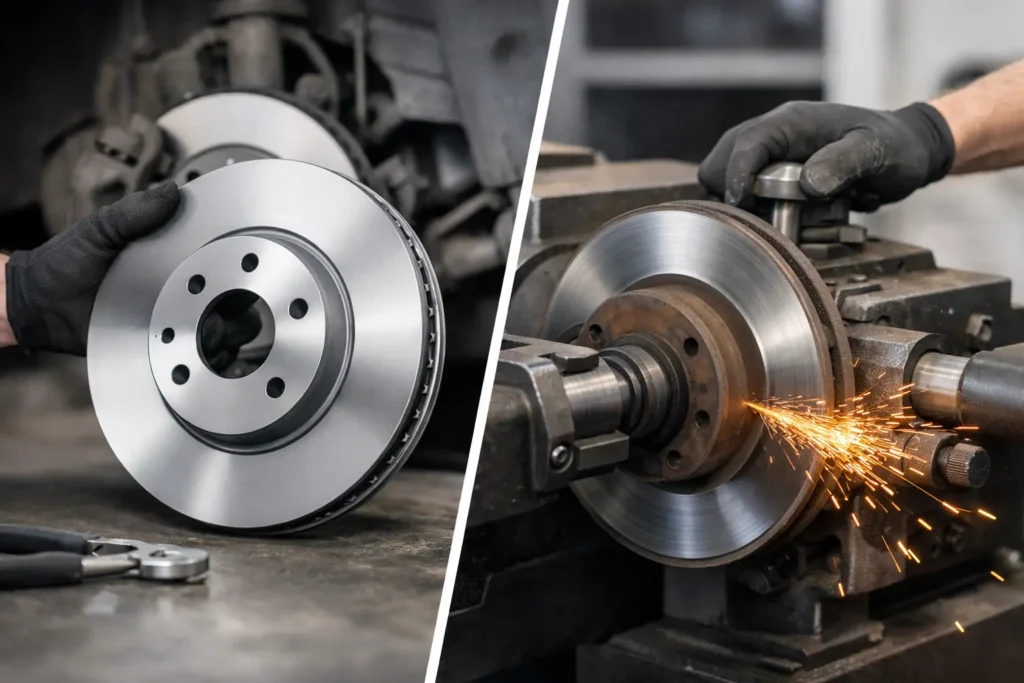
Resurfacing means machining the rotor to create a fresh, smooth braking surface. A brake lathe removes a thin layer of metal from both sides to clean up light grooves, minor unevenness, and some brake pulsation issues.
Replacement means removing the old rotor and installing a new one. That gives you full rotor thickness again, a clean surface, and no guesswork about hidden heat damage or how much material is left.
Both options can solve a problem, but they are not equally right for every rotor.
When resurfacing makes sense
Resurfacing can be a good call when the rotor still has enough thickness left and the surface damage is fairly minor. If the rotor is smooth enough structurally, has no deep cracks, and is not badly heat-spotted, machining it may restore proper contact between the pads and rotor.
This option is often considered when a vehicle has light pulsation, modest scoring, or uneven pad transfer. In the right situation, resurfacing can save some money and return braking to a smooth, predictable feel.
That said, resurfacing only works if the rotor remains above minimum thickness after machining. Every rotor has a manufacturer specification for how thin it can safely be. If cutting the surface would take it below that limit, resurfacing is off the table.
There is another practical issue too: some modern rotors start fairly thin from the factory. On many newer vehicles, there simply is not much material available to machine. That is one reason rotor replacement has become more common than it used to be.
Good candidates for resurfacing
A rotor may be worth resurfacing if it has light wear, no structural cracks, no serious blue heat spots, and enough thickness left after machining. It also helps if the braking complaint is mild and the rest of the brake hardware is in solid shape.
When all of those boxes are checked, resurfacing can be a sensible repair rather than a shortcut.
When replacement is the better option
Replacement is usually the better choice when the rotors are too thin, deeply grooved, cracked, rust-damaged, or badly overheated. If the surface has hard spots from excess heat, machining may not fully solve the issue. The brake may still pulse or wear pads unevenly afterward.
In Minnesota, rust also changes the conversation. A rotor can look decent on the braking surface but still be heavily corroded around the edges or cooling fins. That corrosion can weaken the rotor, affect heat dissipation, and make resurfacing a poor long-term bet.
Replacement also tends to make more sense when you want a cleaner reset on the brake system. New pads bed in more predictably on new rotors. In many cases, that means fewer noise complaints, less chance of comeback issues, and better long-term value even if the upfront price is higher.
Signs a rotor should be replaced, not cut
Deep grooves, visible cracking, blue discoloration from heat, severe rust scaling, and thickness near the discard limit are all warning signs. So is any rotor that would fall below spec after machining.
If a rotor has already been resurfaced before, that matters too. There may not be enough material left to do it again safely.
Why brake pulsation does not always mean “warped rotors”
A lot of people describe the problem as warped rotors. Sometimes that is partly true, but often the issue is uneven pad material transferred onto the rotor surface. That unevenness creates variation as the pads clamp down, and the driver feels it as pulsation.
Resurfacing can sometimes correct that. Replacement can too. The right answer depends on what caused the issue in the first place and what shape the rotor is in now.
This is also why a proper brake inspection matters. You do not want someone guessing based only on a quick road test or automatically selling rotors every time pads are changed. The smart approach is to measure rotor thickness, inspect the surface, check for heat damage, and look at the whole brake system.
Cost matters, but so does value
On paper, resurfacing usually costs less than replacement. That is what makes it appealing. But lower cost today is not always better value over the life of the repair.
If resurfacing leaves you with a rotor that is technically usable but already fairly thin, it may run hotter and wear out sooner. You could end up paying for brake work again earlier than expected. On the other hand, if the rotor is healthy and only needs a light cleanup, replacing it may be unnecessary spending.
That is really the heart of rotor replacement vs resurfacing. The cheapest option is not always the best option, and the most expensive option is not automatically the honest one either.
A good shop should be able to explain why one choice makes more sense for your vehicle. That explanation should include measurements and condition, not just sales talk.
What many drivers really want to know
Most people are not asking for a machining lesson. They want to know three things: Is my vehicle safe, am I being sold something I do not need, and will this fix the problem the first time?
Those are fair questions. And in brake work, the right answer is often tied to doing complete, compatible repairs. If pads are worn unevenly, caliper hardware is sticky, or slide pins are binding, rotor work alone will not solve the bigger issue. That is how brake noise and pulsation come back.
Done right means looking at the full system, not just swapping parts until the symptom changes.
How a trustworthy brake shop makes the call
A good brake recommendation should be based on inspection, measurement, and experience with real-world wear patterns. That includes checking rotor thickness, surface condition, rust, hot spots, pad wear, caliper operation, and how the vehicle is actually being used.
A commuter car that sees mostly highway miles may have a different answer than a half-ton pickup that hauls, tows, or handles constant stop-and-go driving. The same goes for vehicles that sit outside through snow, salt, and temperature swings.
At All Tire, that practical side matters. The job is not to force every vehicle into the same repair pattern. It is to recommend what holds up, brakes smoothly, and makes sense for the customer in front of us. If you want a local brake shop to inspect what is going on before you decide, our brake shop in Elk River can help.
So which one should you choose?
If the rotors are thick enough, lightly worn, and free of serious heat or rust damage, resurfacing may be a solid way to restore braking performance without overspending. If the rotors are thin, heavily worn, heat-damaged, or rusted out, replacement is usually the smarter and safer move.
What you want to avoid is treating every brake job the same. Some vehicles genuinely need new rotors. Some do not. The difference comes down to condition, specs, and whether the repair will still be right after a few thousand miles – not just when the car leaves the bay.
If your brakes are pulsing, grinding, squealing, or just not giving you confidence, get them checked before it turns into a bigger repair. A clear inspection and honest recommendation can save money, protect your pads and calipers, and make sure your vehicle stops the way it should when the road gets busy, slick, or unpredictable.
