

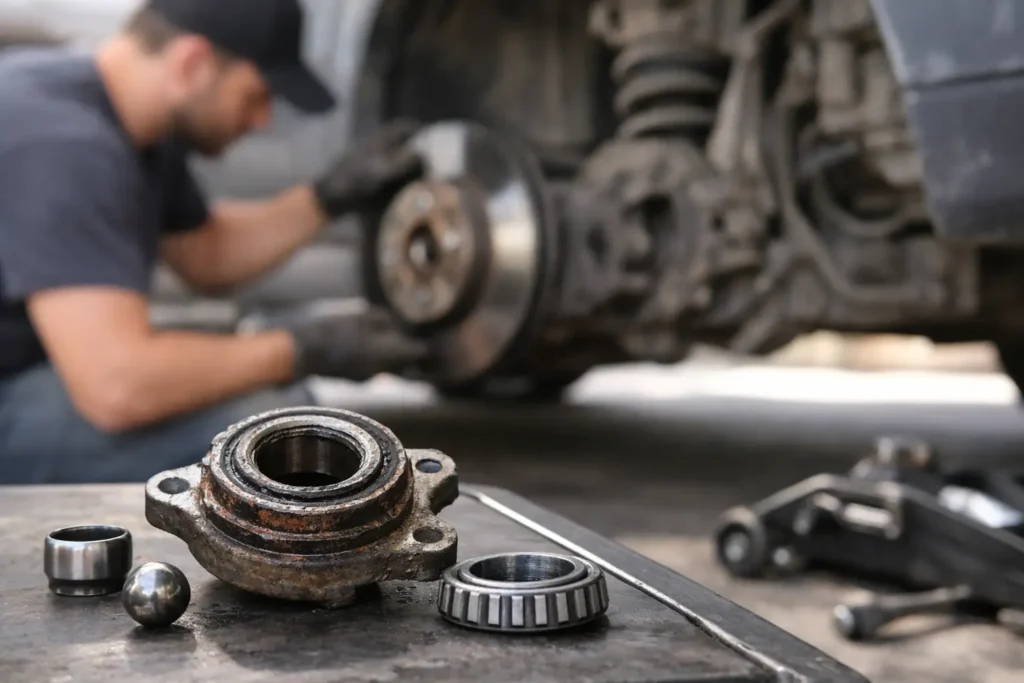
A wheel bearing problem rarely starts with a dramatic breakdown. More often, it begins as a low hum on the drive home from Elk River, a vibration you feel through the floor, or a noise that seems louder after a Minnesota pothole season. Knowing the best signs of bad wheel bearings gives you a chance to get the vehicle checked before a small warning turns into a safety issue.
Wheel bearings let each wheel rotate smoothly while carrying a tremendous amount of vehicle weight. When one starts wearing out, it can affect handling, tire wear, braking feel, and eventually the wheel’s ability to stay properly supported. The good news is that the symptoms are usually noticeable when you know what to listen and feel for.
The Best Signs of Bad Wheel Bearings
1. A humming, growling, or roaring sound that changes with speed
The most common wheel-bearing warning is a steady humming, growling, grinding, or roaring sound that gets louder as road speed increases. It may begin around 30 mph and become more obvious at highway speed. Unlike an engine noise, it usually doesn’t change much when you accelerate or let off the gas. It follows the vehicle’s speed because the wheels are turning faster.
Drivers sometimes describe it as sounding like aggressive tire tread, especially when they first hear it. That’s understandable. Open shoulder tires, for example, can have more road sound than a quiet touring tire, but their design brings valuable benefits for clearing water in summer rain and finding traction through Minnesota snow and slush. A bearing noise is different because it often has a rough, droning tone that wasn’t there before.
2. The noise changes when you turn
A worn bearing may get louder or quieter when the vehicle’s weight shifts during a gradual turn. If a noise gets louder in a gentle left-hand curve, the issue may be on the right side, because that outside wheel takes more load. A noise that increases in a right-hand curve can point to the left side.
That’s a useful clue, not a final diagnosis. Tire cupping, uneven tread wear, and other drivetrain issues can also change sound while cornering. At Joe’s All Tire, we don’t guess based on one symptom. We check the vehicle so you know what actually needs attention.
3. Vibration in the steering wheel, seat, or floor
A failing wheel bearing can create vibration, although it’s usually more noticeable once the wear has progressed. You might feel it in the steering wheel if the problem is at the front, or through the seat and floor if it’s at the rear. Some drivers notice it only at certain speeds.
Vibration deserves a proper inspection because there are several possible causes. A wheel that needs balancing, a bent wheel, a damaged tire, loose suspension components, brake problems, and wheel bearings can all produce similar sensations. Replacing parts without diagnosing the source is how a simple repair gets expensive.
4. Looseness or wandering in the steering
A badly worn front wheel bearing can allow extra movement at the wheel. You may feel the vehicle wander, pull slightly, or require more small steering corrections than usual. The steering might not feel as solid or predictable, particularly on uneven roads.
Don’t ignore this symptom just because the vehicle still drives. A little looseness can become a lot of looseness, and the wheel bearing isn’t the only part that may be affected. Ball joints, tie rods, and suspension parts should be checked too. When your vehicle doesn’t feel planted on the road, it’s time to find out why.
5. Uneven tire wear that doesn’t make sense
Wheel bearing wear can change how the tire meets the road, which may contribute to uneven wear over time. You may see unusual wear on one tire, especially when paired with a vibration or humming noise. It’s not the most reliable symptom by itself, because alignment, inflation, suspension wear, and tire condition are more common causes.
Still, tires can tell a helpful story. At All Tire, we look at tread wear as part of the diagnosis instead of treating the tire and bearing as unrelated problems. That matters in Minnesota, where reliable traction in rain, ice, and snow depends on both good tires and a vehicle that holds them straight and stable.
6. A clunk, click, or metallic grinding near one wheel
A worn bearing can eventually cause clunking or clicking as internal parts develop excessive play. In severe cases, you may hear metallic grinding. These sounds can be especially noticeable over bumps, while turning, or when slowing down.
Keep in mind that brake hardware, CV joints, suspension components, and loose lug nuts can also make noises near the wheel. A clicking sound on turns is often associated with a CV joint, while brake issues may change when you apply the pedal. The point isn’t to diagnose it from the driver’s seat. The point is to recognize that a new wheel-area noise needs attention.
7. An ABS or traction-control warning light
Many modern vehicles use the wheel-speed sensor near the hub assembly. When a wheel bearing or hub begins to fail, damage or movement around that area can interfere with the sensor signal. That can trigger an ABS, traction-control, or stability-control warning light.
A warning light doesn’t automatically mean the bearing is bad. It could be the sensor, wiring, tone ring, or another issue. But when the light appears along with a hum, vibration, or wheel noise, the bearing should be part of the inspection.
8. Visible wheel play or a wheel that feels hot
This is the serious end of the symptom list. With the vehicle safely lifted, a technician may find movement when checking the wheel by hand. A failing bearing can also create excess heat, sometimes leaving one wheel area noticeably hotter than the others after driving.
Don’t try to touch a wheel or brake area immediately after a drive. Brake components can be extremely hot, and heat alone can also point to a sticking brake caliper. Either way, a hot wheel area is not something to put off.
Why Minnesota Roads Can Be Hard on Wheel Bearings
Wheel bearings are sealed components on many vehicles, but they still live in a rough environment. Potholes, curb impacts, rough gravel roads, deep slush, standing water, and years of temperature swings all add stress. A hard hit doesn’t guarantee bearing damage, but it can shorten the life of a part that was already wearing down.
Wheel bearings can also fail because of age, high mileage, improper installation, or a damaged seal that lets moisture and contamination in. That’s why the repair method matters. The right tools, correct torque, and a careful inspection of surrounding parts are part of getting the job done right the first time.
How Urgent Is a Bad Wheel Bearing?
It depends on the symptom and how far the wear has progressed. A mild hum that has just started may allow enough time to schedule an inspection soon. But loud grinding, obvious vibration, steering looseness, a hot wheel, or visible wheel play means the vehicle should be checked right away. If the steering feels unstable or the wheel appears loose, don’t keep driving it.
Waiting can turn a bearing replacement into a hub, sensor, axle, brake, or tire issue. More importantly, it can compromise how safely the vehicle handles. For families, commuters, and truck owners who rely on their vehicle every day, that isn’t a repair worth gambling on.
If you’re hearing a new hum or feeling a vibration and aren’t sure whether it’s tires, brakes, or a bearing, Joe at All Tire can help sort it out clearly. Mobile visitors can tap the blue call button in the lower left corner to ask questions or schedule an appointment.
What a Proper Wheel Bearing Diagnosis Looks Like
A good diagnosis starts with listening to the customer. When does the noise happen? Does it change during turns, braking, or acceleration? Is there a recent pothole hit, tire replacement, or brake repair that could be relevant?
From there, the vehicle should be road-tested when appropriate and inspected on a lift. A technician checks for wheel play, rotates the wheel by hand, listens for roughness, inspects tire condition, and looks at brakes, suspension, and steering components that can mimic bearing trouble. On vehicles with warning lights, scan data may also help identify a wheel-speed signal issue.
That process matters because a noisy tire can sound remarkably similar to a bearing, and replacing a bearing won’t fix cupped tread. Honest advice means telling you the difference, even when the answer is less convenient than a quick guess.
A wheel bearing doesn’t need to ruin your week. Pay attention to new road noise, vibration, and changes in how your vehicle feels, then get a straight answer before the problem has time to grow.