

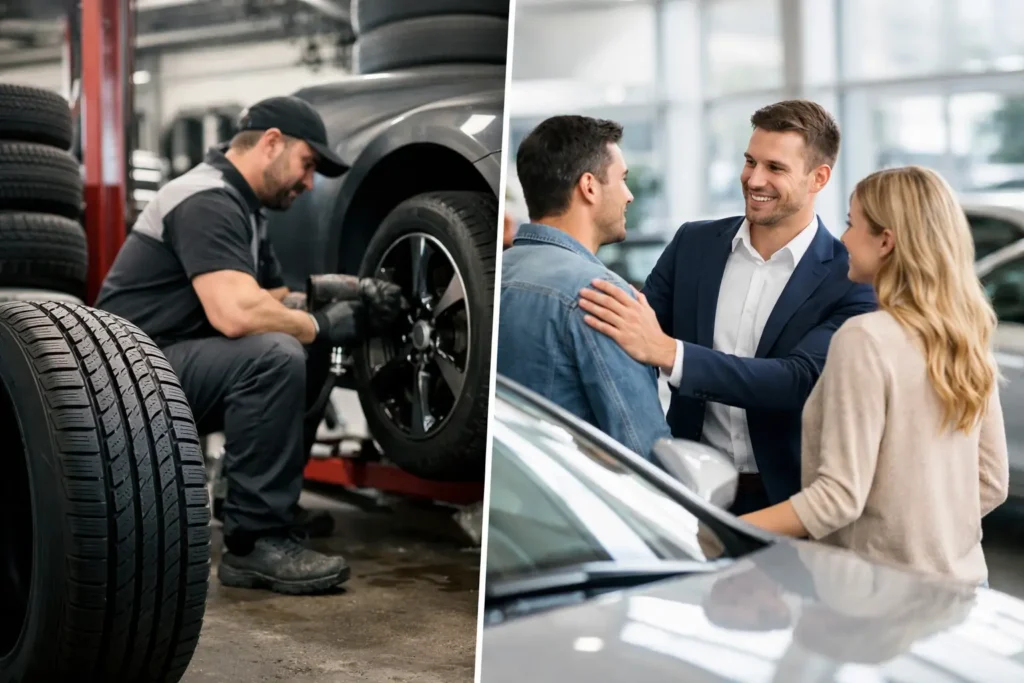
You notice it when the steering wheel starts to shake, the tread looks thin, or the service advisor hands you an estimate that feels a lot bigger than expected. That is usually when the tire shop versus dealership question gets real. Most drivers are not trying to become tire experts. They just want the right fix, a fair price, and confidence that the work was done right.
For a lot of routine tire and wheel work, a dedicated tire shop is the better fit. For some warranty and brand-specific repair situations, the dealership still makes sense. The right answer depends on what your vehicle needs, how quickly you need it handled, and whether you are getting advice from someone focused on solving the problem or selling around it.
If you are trying to sort out which option makes the most sense for your vehicle, it helps to talk it through with someone who does this every day. Just tap the blue phone call button in the lower left corner – we’re just a call away.
Tire shop versus dealership for everyday service
If you need tires, a flat repair, balancing, rotation, TPMS work, vibration diagnosis, or brake and wheel-end inspection related to tire wear, a tire shop usually has the advantage. That is the core of the work. The technicians see the same real-world tire issues all day long, from road hazard damage to irregular wear patterns to trailer tire problems that bigger operations often treat like an afterthought.
A dealership is built around the vehicle brand. That can be helpful when the job involves factory warranty questions, software, or model-specific repair procedures outside the tire and brake category. But when the problem is centered on tires, wheels, alignment symptoms, or everyday wear items, the dealership is often not more specialized. It is just more branded.
That difference matters because tires are not one-size-fits-all, even when the size matches. The right tread design, load rating, and seasonal performance can change how the vehicle handles in heavy rain, slush, packed snow, and highway driving. In Minnesota, that is not a small detail.
Price is not the only difference
Most people assume a tire shop wins on price, and often that is true. Tire shops usually have broader access to multiple tire brands and price points, including practical options for drivers who want solid performance without paying for a name they do not need. Dealerships often have fewer choices and a structure that tends to push the estimate higher.
But the better question is value. A cheaper tire that does not match your driving habits can cost more over time. A more expensive option that is wrong for Minnesota roads can be a bad buy too. That is where honest recommendations matter.
A good local tire shop should explain what you are paying for in plain language. You should hear things like how the tire will wear, how it handles rain, whether it is a good fit for a half-ton truck, and whether it is worth spending more for your commute and mileage. You should not feel like you are being walked toward the highest number on the screen.
At All Tire, one point we stress often is open shoulder tire design when it fits the vehicle and driving conditions. For many cars and trucks here, open shoulder tires can improve summer rain evacuation and winter traction, which matters when we deal with months of snow, slush, and ice. Tread design is not sales fluff. It affects stopping, cornering, and how planted the vehicle feels on messy roads.
Where a tire shop usually does better
A dedicated tire shop tends to be stronger in the areas that matter most to everyday drivers. First is tire selection. Instead of being tied closely to one brand ecosystem, the shop can usually match the tire to the driver, not the other way around.
Second is pattern recognition. When a customer comes in with a vibration, edge wear, cupping, or a TPMS light, an experienced tire shop sees those issues constantly. That means faster diagnosis and fewer guesses. Sometimes the problem is the tire. Sometimes it is a bent wheel, a balance issue, a wheel bearing, inflation neglect, or a brake concern showing up through the steering wheel. Shops that live in this lane tend to catch the whole picture.
Third is speed. Tire shops are generally set up to handle tire-related work efficiently. Dealerships juggle warranty work, engine diagnosis, recalls, and larger repair jobs, so simple tire service can end up moving slower than it should.
There is also the service experience. At a local owner-led shop, recommendations are often more direct and accountable. That matters when you are deciding whether to repair one tire, replace two, or replace a full set. It matters when someone tells you a tire can be safely repaired – or should not be.
If you want to understand more about tread patterns, seasonal choices, and why certain tire designs perform better in Minnesota conditions, our tire knowledge center at www.joesalltire.com/knowledge-center/ is a good place to start.
When the dealership makes sense
This is not a case where the dealership is always the wrong choice. There are situations where it is the right one.
If your vehicle is under a factory program tied to tire replacement, road hazard coverage, or a brand-specific service package, the dealership may be the simplest route. The same goes for repairs that depend on manufacturer software, calibration procedures, or systems outside the normal tire and wheel category.
Some drivers also prefer the dealership because everything for the vehicle is handled in one place. That convenience is real. If you are already there for major service and need tires at the same time, bundling it may be worth it.
Still, convenience should not replace comparison. It is smart to ask what tire is being quoted, why that model was chosen, whether there are other options, and what is actually included in the total. A higher estimate is not automatically better service.
The trust factor matters more than people think
Most tire decisions are made under pressure. A flat tire before work, cords showing on the front tires, or a vibration before a weekend trip is not the kind of problem people want to research for three days. That is exactly why trust matters.
A good shop should tell you when a repair is appropriate and when it is not. They should explain why a tire cannot be patched, why uneven wear points to another issue, or why replacing one tire on an all-wheel-drive vehicle may create problems. They should also tell you when you do not need the expensive option.
That kind of honesty is harder to fake in a local business where reputation sticks. When the owner is on site and stands behind the recommendation, people can feel the difference. It is less about polished sales process and more about whether the work is done correctly the first time.
How to decide between a tire shop and a dealership
Start with the actual problem. If you need tire replacement, repair, balancing, rotation, TPMS service, or help figuring out a vibration or wear issue, begin with a trusted tire shop. If the issue is tied to factory systems, warranty administration, or dealer-only procedures, the dealership may be the better first call.
Then look at the estimate. Not just the total, but what is included. Ask about the tire model, install, balancing, valve service, TPMS parts if needed, disposal, road hazard terms, and warranty. Good shops answer those questions clearly.
Finally, pay attention to how the recommendation is delivered. Are you getting real explanation, or are you being rushed into the most expensive package? Are they asking about your commute, your mileage, and whether your vehicle sees snow, towing, or gravel roads? The right recommendation usually sounds practical, not theatrical.
For most local drivers, the best answer in the tire shop versus dealership debate comes down to specialization and trust. Tires are a major safety item. So are the related parts that affect how they wear and how your vehicle stops, steers, and tracks down the road. You want the place that pays attention to those details every day.
That is why many people choose a local tire-focused shop instead of a larger dealership lane. They want honest advice, solid tire options, proper installation, and someone who will stand behind the work without turning a simple problem into a sales event.
When your vehicle starts telling you something is off, the best move is usually the one that gets you clear answers fast. Choose the shop that treats your safety like the job, not the upsell.
