

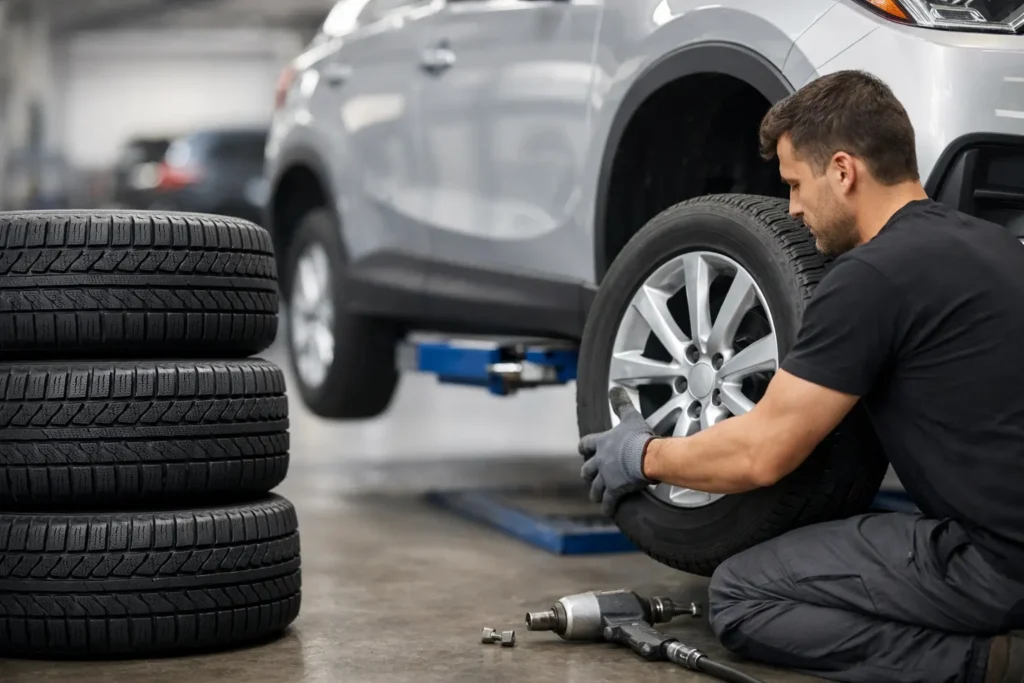
If your front tires look more worn than the rear, or your truck starts feeling a little rougher on the road than it used to, the question usually comes next – when should tires be rotated? For most drivers, the answer is every 5,000 to 7,500 miles. But that range is only a starting point. The right interval depends on your vehicle, your tire type, your driving habits, and the roads you deal with through a Minnesota winter.
Tire rotation is one of the simplest services that protects the money you already spent on tires. It helps the tires wear more evenly, keeps the ride smoother, and can help you get the full life out of the set instead of replacing two early and hoping the other two still have enough tread left.
When should tires be rotated for most vehicles?
For most cars, SUVs, and light trucks, tires should be rotated about every 5,000 to 7,500 miles. A lot of drivers line it up with an oil change because it is easier to remember. That works well as long as the vehicle’s oil service interval is not so long that tire rotation gets skipped for 10,000 miles or more.
If you want the safest answer, check the owner’s manual first. Some manufacturers give a more specific mileage interval, and that recommendation should always come before a general rule. If you drive a front-wheel-drive vehicle, staying on schedule matters even more because the front tires usually do the steering, much of the braking, and the power delivery. They wear faster, plain and simple.
All-wheel drive vehicles also need close attention. Uneven tread depth can create drivability issues and put extra strain on AWD components. Regular rotation helps keep tread wear more consistent across all four tires.
Why tire rotation matters more than many drivers think
A lot of people assume tire rotation is mainly about getting a little more tread life. That is true, but it is not the whole story. Rotation also helps maintain predictable handling and braking. When one pair of tires is significantly more worn than the other, your vehicle may not respond the same way in rain, slush, or snow.
That matters here. In Minnesota, where snow and ice can stick around for months, even tire wear is not just a maintenance detail. It affects traction when roads are slick and stopping distances get longer. A good tread pattern only helps if all four tires still have usable tread depth.
This is also where tire design comes into the conversation. Open shoulder tires are often a smart choice for cars and trucks that deal with winter roads because they can improve traction by helping move slush and snow through the tread more effectively. If you want to learn more about tread patterns and how they affect seasonal driving, our tire knowledge center covers that in plain language.
What changes the rotation interval?
The 5,000 to 7,500 mile guideline works for many drivers, but some vehicles should be rotated sooner.
If you drive rough roads, make lots of short trips, carry heavy loads, tow, or spend a lot of time braking and accelerating in traffic, your tires can wear faster and less evenly. The same goes for pickup owners whose trucks see a mix of unloaded driving during the week and hauling on weekends. Those use patterns change how the tires wear.
Tire type matters too. Some performance tires wear more quickly by nature. Some trucks have aggressive all-terrain tread that can get noisy or irregular if rotations are delayed. And if your alignment is off, rotation will not fix the root problem. It may spread the wear around, but it will not stop it.
That is why honest tire service should never be just moving tires front to back and calling it good. A proper rotation is also a chance to inspect tread wear, air pressure, condition, and signs that something else is going on.
When should tires be rotated sooner?
There are a few situations where waiting for the normal interval is not the best move.
If you notice uneven wear across the tread, feathering, cupping, or one tire wearing faster than the others, it is time to have them checked. If the steering feels off-center, the vehicle pulls, or you feel a vibration at highway speed, that is another sign not to wait. The issue may be balance, alignment, suspension wear, or even a tire defect.
Seasonal timing can matter as well. If you are heading into winter with a set that has not been rotated in a while, it is smart to get them inspected before snow season gets serious. That is especially true for drivers who rely on one set year-round. Even wear helps all four tires do their job when traction is limited.
Rotation patterns are not all the same
This part gets overlooked. Not every vehicle uses the same rotation pattern.
Many standard setups can use a forward cross or rearward cross pattern, depending on whether the vehicle is front-wheel drive or rear-wheel drive. If the tires are directional, they usually must stay on the same side of the vehicle and move front to rear only. If your car has staggered sizes, meaning different tire sizes in front and back, rotation options may be limited or not possible at all unless the setup allows side-to-side movement.
That is one reason DIY rotation is not always as simple as it sounds. The correct pattern matters, proper torque matters, and tire pressure should be adjusted before the job is considered done.
Tire rotation does not replace alignment or balancing
Rotation is important, but it is not a cure-all.
If your tires are wearing unevenly because the alignment is out, rotating them without correcting alignment just shifts the problem to another position. If the vibration you feel is caused by a wheel balance issue or a bent wheel, rotation may change where you feel it, but it will not solve it.
A good shop looks at the whole picture. If a tire shows shoulder wear, center wear, cupping, or diagonal wear, those patterns tell a story. Sometimes the fix is simple. Sometimes the right answer is alignment, suspension work, or replacing a damaged tire before it becomes a safety issue.
How to know if your tires have been rotated often enough
You do not need to be a tire expert to catch early signs.
Look at the tread across all four tires every so often. If the fronts are noticeably lower than the rears, you are probably overdue. If one edge is wearing more than the other, there may be an alignment issue. If the tread blocks feel choppy by hand or the ride gets louder than usual, irregular wear may be starting.
You can also watch for changes in braking feel or wet-road traction. Tires usually do not go from good to bad overnight. Most problems show up gradually. Catching them early gives you more options and often saves money.
A practical schedule that works for most local drivers
If you want a simple habit, have your tires rotated every 5,000 to 7,500 miles and inspected at the same time. If your driving is harder than average, closer to 5,000 is the better target. If your vehicle manual gives a shorter interval, follow that.
For drivers dealing with snow, potholes, changing temperatures, and mixed road conditions, consistency matters more than trying to stretch every service as long as possible. Tires are not just another maintenance item. They are what hold your vehicle to the road.
At Joe’s All Tire, or as many locals know us, All Tire, this is the kind of service that should be done right the first time. Not rushed, not oversold, and not treated like a throw-in. A proper tire rotation is a chance to spot wear issues early, protect your investment, and keep your vehicle safer through every season.
If you cannot remember the last time your tires were rotated, that is probably your answer. Get them checked before uneven wear turns into an early replacement bill. A little attention now usually saves a lot more later – and it helps keep your vehicle steady when the road is anything but.