

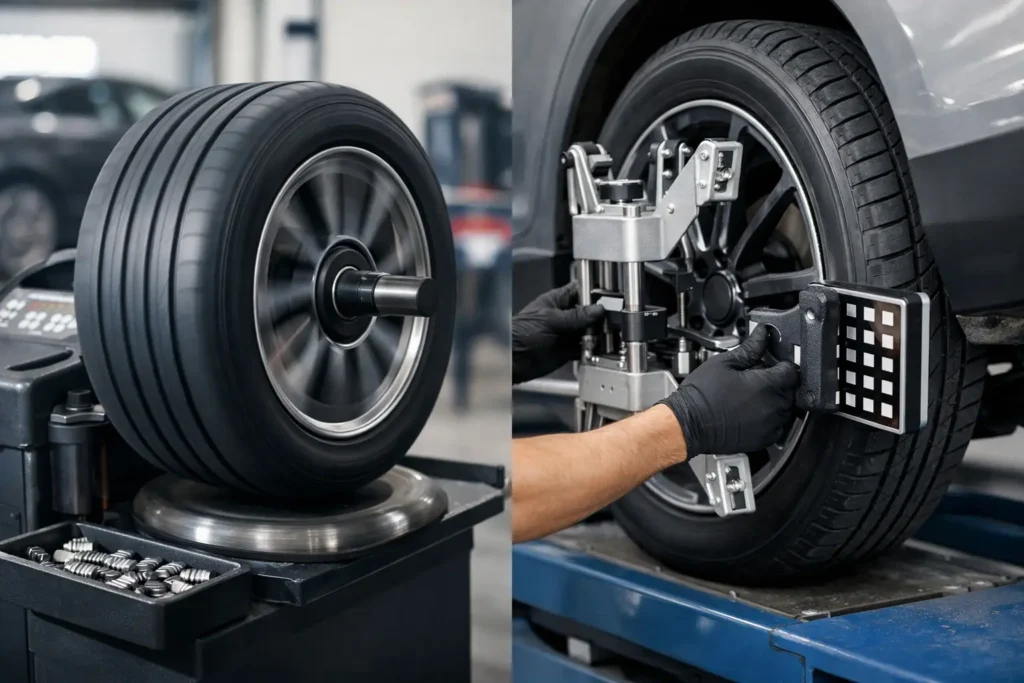
A steering wheel that shakes at 60 mph and a vehicle that pulls to one side can feel like the same problem when you’re behind the wheel. They are not. Understanding tire balancing vs alignment differences helps you spend money in the right place, fix the real issue, and avoid wearing out a good set of tires before their time.
Around here, that matters. Minnesota roads put a lot on tires and suspension parts between potholes, frost heaves, rough shoulders, and long months of snow and ice. If your vehicle starts vibrating, drifting, or chewing up tread, the fix depends on what the symptoms are actually telling you.
Tire balancing Vs alignment differences: the short version
Tire balancing corrects uneven weight in the tire and wheel assembly. Alignment corrects the angles at which the wheels meet the road. Balancing is mainly about vibration and smooth rotation. Alignment is mainly about tracking straight, steering feel, and tire wear.
That sounds simple, but the confusion comes from overlap. A vehicle with a balance problem can feel rough and annoying. A vehicle with an alignment problem can feel unstable and wear tires fast. Sometimes both are off at the same time, especially after hitting a pothole, replacing tires, or driving for a while on worn suspension parts.
What tire balancing actually does
When a tire and wheel assembly spins, even a small weight difference can turn into a noticeable shake. Tire balancing uses small weights to even out that assembly so it spins smoothly at speed.
If a tire is out of balance, the most common symptom is vibration that gets worse as speed rises. You may feel it in the steering wheel, the seat, or the floor. Front tire balance issues often show up more in the steering wheel. Rear tire balance issues can feel more like a body shake through the seat.
Balancing does not change the direction the wheels point. It does not fix a pull. It does not correct camber, caster, or toe. It simply helps the tire roll without that uneven spinning force beating on the vehicle mile after mile.
A proper balance job matters more than some drivers realize. Poor balance can lead to cupping, irregular wear, extra stress on suspension components, and a less comfortable ride. It can also mask other problems. If a shop balances a tire but misses a bent wheel, bad tire, or worn bearing, the shake may come right back.
What wheel alignment actually does
Alignment adjusts the wheel angles so the vehicle drives straight and the tires contact the road correctly. The main settings are toe, camber, and caster.
Toe affects whether the tires point slightly inward or outward. Camber is the inward or outward tilt of the tire when viewed from the front. Caster influences steering stability and return-to-center feel. If those angles are out of spec, the vehicle may pull, the steering wheel may sit crooked, and the tires may wear down unevenly.
Alignment is less about a shake and more about direction and contact. A vehicle that needs alignment may wander on the highway, drift left or right, or feel like you’re always making small steering corrections. You may also notice one shoulder of the tread wearing faster than the other.
In Minnesota, alignment matters even more than many people think. Snow, slush, standing water, and rough pavement already ask a lot from the contact patch. If the tires are not meeting the road squarely, traction and braking can suffer. That’s one reason tire choice matters too. Open shoulder tire designs can be a smart fit for many cars and light trucks here because they help with water evacuation in summer rain and improve winter traction in snow and slush. Tread design and proper alignment work together. One cannot make up for the other.
How to tell which one you probably need
The symptoms usually point you in the right direction.
If the main complaint is vibration at certain speeds, especially 50 to 70 mph, balancing is the first suspect. If the steering wheel shakes but the vehicle otherwise tracks straight, balance is often the issue.
If the vehicle pulls to one side, the steering wheel is off-center when driving straight, or the tires show inside-edge or outside-edge wear, alignment is more likely. If you have to keep correcting the wheel on a flat road, that is another strong clue.
But real vehicles are not always that tidy. You can have a tire balance issue and an alignment issue at the same time. You can also have symptoms caused by worn suspension parts, a separated tire, a bent wheel, brake problems, or a failing wheel bearing. That is why honest diagnosis matters. Throwing an alignment at a vibration problem, or a balance at a pull problem, wastes time and money.
Why new tires often need both
A lot of people assume that if they just bought new tires, the job is done once they are mounted and balanced. Not always.
New tires should always be balanced when installed. That part is standard. Alignment, however, depends on the condition of the vehicle and the wear pattern on the old tires. If the old set wore unevenly, there is a reason. If that reason is not corrected, the new set will start wearing the same way.
This is where people get frustrated. They spend good money on tires and then come back months later with edge wear or a steering complaint. The tires were not the real problem. The vehicle needed alignment, or it had worn parts affecting alignment.
Why potholes make this worse
A hard pothole strike can do more than jar your teeth. It can knock alignment out, damage a tire internally, bend a wheel, or trigger vibration that feels like a balance issue. That is especially common after winter when roads break up and vehicles take repeated hits.
If your car drove fine before a pothole and now it pulls or shakes, do not guess. The right fix depends on what changed. A bent wheel will not be cured by alignment. A toe problem from impact will not be cured by balancing.
Tire wear tells the story
Tread wear is one of the best clues in this whole conversation.
If you see patchy, scalloped, or cupped wear, balance or suspension issues may be involved. If one edge is wearing much faster than the other, alignment is more likely. If both front tires are feathering across the tread, toe settings may be off. If only one tire is wearing oddly, it may be a localized issue rather than a full-vehicle problem.
This is also why tire rotations and regular inspections matter. They catch small wear issues before they turn into a full set of ruined tires. If you want to understand more about tire wear patterns, tread design, and what works best for our road conditions, the tire knowledge center at www.joesalltire.com/knowledge-center/ is a useful place to start.
The service trade-off most drivers miss
Balancing is usually quicker and less expensive than alignment. That can tempt people to start there every time. Sometimes that works. Sometimes it only delays the real fix.
Alignment, on the other hand, can protect tire life in a big way, but it only pays off if the suspension and steering parts are in good shape. If tie rods, ball joints, or control arm components are worn, an alignment may not hold. A good shop should tell you that before making adjustments.
So the right question is not, Which service is better? It is, Which problem is my vehicle actually having?
When you may need both
There are plenty of cases where both services make sense together. Installing new tires is one. Hitting road damage and then noticing both a shake and a pull is another. Buying a used vehicle with unknown maintenance history is another strong candidate.
If your vehicle has uneven tire wear and highway vibration, balancing without checking alignment leaves half the issue untouched. If it tracks poorly and also has a speed-related shake, alignment alone will not make the ride smooth. That is why a good inspection matters more than a canned recommendation.
At All Tire, that practical approach is what people appreciate. Not every problem needs the biggest ticket. But the correct fix should be done right the first time.
The bottom line for everyday drivers
Tire balancing and alignment are different services with different jobs. Balancing fixes rotational weight issues that cause vibration. Alignment corrects wheel angles that affect steering, tracking, and tire wear. One is not a substitute for the other.
If your vehicle is shaking, pulling, or wearing tires unevenly, the safest move is to have the symptoms checked before the damage gets expensive. Tires are not cheap, and neither is the extra wear placed on suspension and steering parts when a problem is ignored.
A smooth ride is nice. Straight tracking is nice too. But the bigger point is control. When your tires are balanced and your alignment is correct, the vehicle feels predictable, your tread lasts longer, and you have a better shot at getting the traction your tires were built to deliver when the road turns wet, slick, or snow-covered.