

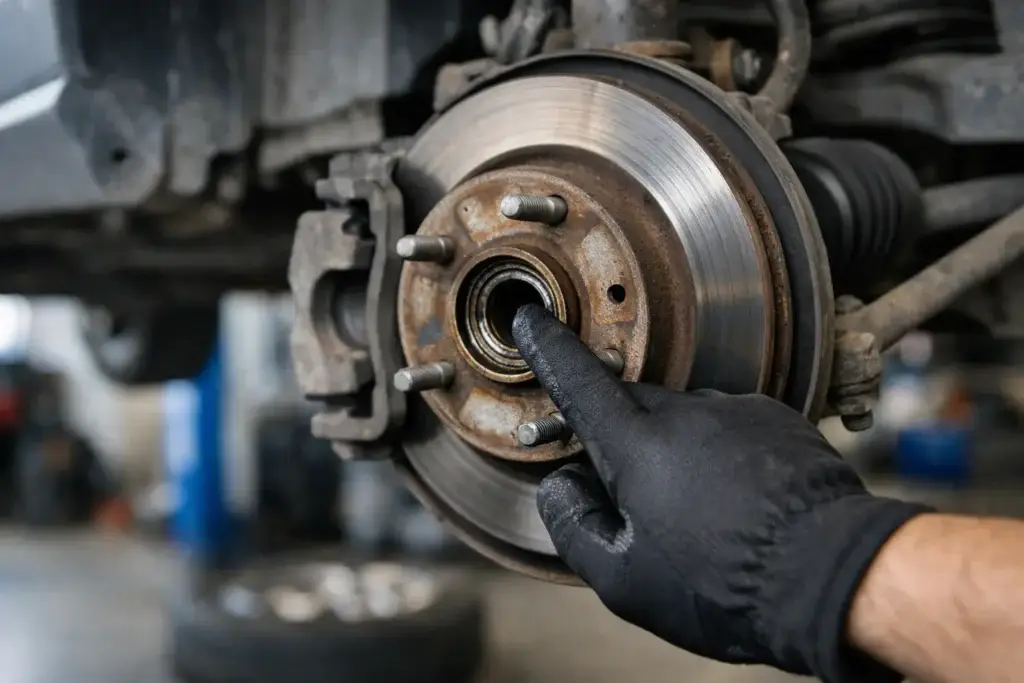
You usually hear a bad wheel bearing before you ever see a problem. It starts as a low humming noise, then turns into a growl or rumble that seems to follow your speed. If you’re wondering how to spot bad wheel bearings, the key is paying attention to changes in noise, vibration, and how your vehicle feels on the road.
A lot of drivers assume the sound is just rough pavement, aggressive tire tread, or an alignment issue. Sometimes it is. But when a wheel bearing starts failing, waiting too long can lead to more than an annoying noise. It can affect steering feel, tire wear, and overall safety. If something feels off and you want a straight answer before it gets worse, just tap the blue phone call button in the lower left corner – we’re just a call away.
How to spot bad wheel bearings while driving
The most common clue is a humming, grinding, or growling sound that changes with vehicle speed. It often gets louder the faster you go. Some people describe it like driving on a rough mud tire, even when their tires are normal.
What makes wheel bearing noise tricky is that it can sound a lot like tire noise. That matters in Minnesota, where drivers swap between different tread styles and often drive on rough winter roads for months at a time. Open shoulder tire designs can create more noticeable road sound than closed shoulder patterns, especially on certain pavement. That does not mean the tire is the problem, and it does not mean the bearing is either. You have to look at the whole picture.
A bad wheel bearing may also change sound when you gently steer left or right. For example, if the noise gets louder when the vehicle’s weight shifts one direction in a curve, that can point toward a bearing on one side of the vehicle. It is not a perfect rule every time, but it is one of the patterns technicians look for.
Vibration is another warning sign. If you feel a buzz in the steering wheel, floor, or seat that was not there before, a wheel bearing is one possible cause. So are tire balance problems, damaged tires, brake issues, and suspension wear. That is why guessing can waste money fast. The right repair starts with a proper diagnosis.
Common signs of a bad wheel bearing
When people search for how to spot bad wheel bearings, they are usually noticing one or two symptoms. The more of these you have together, the more likely it is you are dealing with a bearing problem.
A growling or humming noise
This is the classic symptom. The sound usually builds gradually, though sometimes it becomes obvious all at once after hitting a pothole or curbing a wheel. It tends to rise with speed, even if the engine RPM stays the same.
Noise that changes in turns
A bearing under load often gets louder in a sweeping turn or lane change. That said, road surface, tire tread, and uneven wear can also change noise in a turn, so this sign is helpful but not final by itself.
Steering that feels loose or rough
If a bearing has enough wear, the wheel may not track as smoothly as it should. Some drivers describe it as a wandering feeling, a slight looseness, or a vehicle that no longer feels planted.
Uneven tire wear
Not every bad bearing causes visible tire wear right away, but excessive play at the wheel can contribute to unusual wear patterns over time. If your tires are wearing unevenly and there is also noise or vibration, the bearing should be checked along with alignment and suspension parts.
ABS or traction control warning lights
Many modern wheel bearing assemblies include a sensor or tone ring used by the ABS system. If that part is damaged or the bearing develops too much play, it can trigger warning lights. A warning light alone does not prove the bearing is bad, but it can be part of the story.
What causes wheel bearings to go bad?
Wheel bearings are built to handle a lot, but they do not last forever. Age and mileage are the obvious reasons, especially on vehicles that see plenty of highway use, rough roads, or heavy loads.
Impact damage is another common cause. Deep potholes, curb hits, and road debris can shorten bearing life. In our area, winter roads do vehicles no favors. Snow, ice, slush, and freeze-thaw cycles mean more impacts and more moisture exposure over time.
Improper installation can also cause repeat failures. Bearings need to be installed with the correct tools and torque procedures. That is one reason this is not a repair to rush or guess through. Done right matters here.
How to tell wheel bearing noise from tire noise
This is where many people get tripped up. Tire noise and wheel bearing noise can sound very similar from the driver’s seat.
Tire noise often changes based on pavement type. You may hear more of it on coarse asphalt and less on smooth concrete. It can also come from cupped tread, uneven wear, or certain tread designs. Open shoulder tires, which we often recommend for better summer rain evacuation and winter traction, can have a more noticeable road sound than some quieter tread patterns. That trade-off is worth it for many Minnesota drivers, but it means you need someone who can separate normal tread noise from a mechanical problem.
Wheel bearing noise, on the other hand, is usually more tied to speed and load than to tread pattern alone. It often has a deeper hum or growl and may continue across different road surfaces in a more consistent way. Still, there are plenty of cases where the difference is not obvious until the vehicle is inspected.
Can you keep driving with a bad wheel bearing?
Maybe for a short distance, but it is not something to ignore. A mildly noisy bearing does not always fail overnight, but it will not heal itself either. Over time, the play and heat can get worse, and that can affect the hub, tire wear, braking feel, and vehicle stability.
The bigger issue is that there is no perfect timeline. One driver may notice noise for weeks before it gets serious. Another may go from a faint hum to obvious looseness much faster. If the sound is getting louder, the steering feels different, or you notice vibration along with the noise, it is smart to have it looked at sooner rather than later.
How a shop confirms a bad wheel bearing
A real diagnosis usually starts with a road test. The technician listens for how the noise reacts to speed, turns, and load. After that, the vehicle is lifted so the wheel can be checked for roughness, looseness, and any signs of related damage.
That inspection matters because several problems can overlap. Tires can be noisy. Brakes can drag. Suspension parts can create play. A worn bearing can even show up alongside another issue. Replacing parts based on a guess is how people spend money and still leave with the same noise.
At a local shop like All Tire, the value is getting an honest answer from people who deal with vibration, tire wear, wheel-end issues, and bearing problems every day. Sometimes the bearing is clearly the problem. Sometimes the smarter answer is balancing the tires, correcting a wear issue, or addressing another part first.
When to get it checked
If the noise is new, getting louder, or paired with vibration, have it inspected. The same goes for any grinding sound, looseness in the steering, or warning lights that show up with road noise. You do not need to wait until it becomes severe.
This is especially true before a longer trip or heading into another stretch of wet or icy driving. A vehicle that already feels off will not feel better on slick roads. If you are deciding whether the sound is serious enough to schedule, Joe’s All Tire can take a look and tell you plainly what is going on and what actually needs to be fixed.
Bad wheel bearings usually give you some warning. The trick is not brushing off that warning for too long. When your vehicle starts sounding different, feeling rougher, or vibrating in ways it did not before, trust that change and get it checked while the repair is still straightforward.
