

That TPMS light usually shows up at the worst time – cold morning, busy schedule, maybe a tire looks fine, and now you’re left wondering whether it’s a simple pressure change or a bad sensor. If you’ve been trying to figure out how to diagnose TPMS sensor faults without wasting money on guesswork, the key is to separate an actual low-tire problem from an electronic fault.
The first thing to know is that the warning light does not always mean the same thing. Sometimes the system is doing its job and telling you a tire is low. Other times the sensor battery is dying, the sensor was damaged during tire service, or the system just needs to be relearned after a rotation or replacement. If you’re trying to decide whether it’s safe to keep driving or time to get it checked, we can help you sort that out fast. Just tap the blue phone call button in the lower left corner – we’re just a call away.
What the TPMS light is really telling you
A steady TPMS light usually points to low air pressure in one or more tires. A flashing light that turns solid often means the system itself has a fault. That difference matters because adding air might solve the first problem, but it won’t fix a dead sensor battery or a communication issue.
In Minnesota, this gets more confusing once temperatures drop. Cold air lowers tire pressure, so a healthy TPMS system may come on simply because the weather changed overnight. That is normal. If the light goes away after pressures are corrected, the sensors may be working exactly as they should.
If the light stays on even after all four tires are set to the correct pressure, you’re no longer dealing with a basic inflation issue. At that point, diagnosis should focus on the sensors, the relearn procedure, and the system’s ability to read each wheel correctly.
How to diagnose TPMS sensor faults without guessing
Start with the basics. Check all four tires with a quality tire gauge and compare the readings to the door-sticker pressure specification, not the number printed on the tire sidewall. If one tire is low, inspect it for a puncture, bead leak, or seasonal pressure drop. Inflate as needed and drive the vehicle for a few minutes to see whether the system resets.
If all pressures are correct and the light remains on, the next step is to consider what happened recently. Was the vehicle in for new tires, rotation, wheel replacement, brake work, or a dead battery? TPMS faults often show up right after legitimate service because the system may need a relearn, or an aging sensor may fail once it has been disturbed.
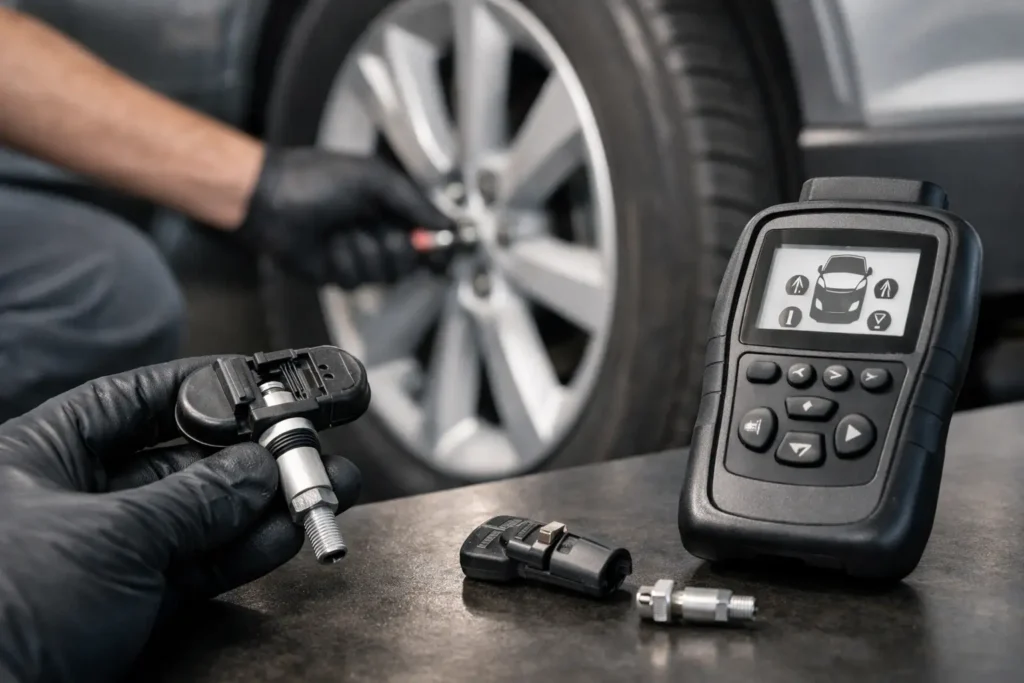
A scan tool or TPMS activation tool is usually the fastest way to pinpoint the issue. This tool can read each sensor individually and show whether it is transmitting, what pressure it reports, what temperature it sees, and often the battery condition. If one wheel will not respond while the others do, that strongly suggests a failed sensor, dead internal battery, or damage to the valve-stem assembly.
This is where proper diagnosis matters. Replacing all four sensors because one light came on is not always honest advice. Sometimes one sensor failed. Sometimes the tires are simply low. Sometimes the sensor IDs were lost and just need to be relearned. A good shop should tell you which it is.
Common causes of TPMS sensor problems
Most TPMS sensors fail because of battery age. The battery is sealed inside the sensor, and in many vehicles it lasts around 7 to 10 years. Once it weakens, the signal becomes unreliable or stops entirely.
Physical damage is another common cause. Sensors can be cracked during tire mounting and dismounting if the work is rushed or done carelessly. Corrosion can also build up around the valve stem, especially in areas where roads see moisture, salt, and winter grime. Around Elk River, that is not a small detail. A vehicle can go through a lot of harsh weather in a year, and that wear adds up.
There are also cases where the sensor itself is fine, but the system lost track of wheel positions after tire rotation. Some vehicles relearn automatically. Others require a manual or scan-tool relearn procedure. If that step gets skipped, the vehicle may show the wrong tire location or trigger a warning that seems to make no sense.
Signs the problem is the sensor and not the tire
A few patterns usually point toward a sensor fault instead of a tire issue. One is a flashing TPMS light at startup. Another is a warning that stays on even after pressures are set correctly and rechecked. You may also notice one tire never shows a pressure reading on the dash in vehicles with individual tire display.
Intermittent warnings can also suggest a weak battery. The light may come on during cold mornings and disappear later in the day. That can happen with actual low pressure too, so it takes a little care to tell the difference. If the pressures are correct every time you check and the warning keeps returning, the sensor becomes the more likely suspect.
A damaged valve stem, slow leak around the stem, or corrosion at the sensor hardware can also point to a sensor assembly problem. In those cases, replacing the full sensor assembly is often the right repair, not just tightening a cap and hoping for the best.
When a relearn is enough and when replacement makes sense
This is where people get tripped up. Not every TPMS warning means you need new parts. If the sensors still transmit and the IDs are present, a relearn may be all that is needed after service. That is a relatively simple fix when done with the right equipment.
Replacement makes more sense when a sensor will not transmit, shows a dead battery, has visible corrosion, or has been physically damaged. If one sensor fails on an older set, some drivers choose to replace all four while the tires are already being serviced. Others replace only the failed unit to keep costs down. Neither approach is automatically wrong. It depends on sensor age, budget, and whether the tires are already off the wheels.
At All Tire, this is the kind of situation where straightforward advice matters more than a sales pitch. If one sensor is bad and the others are still testing strong, you should be told that. If all four are near the end of life and you’re already replacing tires, you should hear that too.
Why tire service quality affects TPMS problems
TPMS lives inside the wheel, so tire work and sensor health go together. Improper mounting technique can damage a perfectly good sensor. Skipping replacement service kits, seals, or valve components can lead to leaks and corrosion later. Good tire work is not just about getting the tire on the rim – it’s about protecting everything attached to that wheel.
That is one reason local drivers often get frustrated with high-volume chain shops. Fast turnaround is nice until a warning light comes on right after service and nobody can explain why. Proper diagnosis means checking the basics first, testing the sensors directly, and confirming the repair before the vehicle leaves.
Since tires and traction go hand in hand, it is also worth remembering that tire condition matters just as much as pressure monitoring. For Minnesota drivers dealing with long stretches of rain, snow, slush, and ice, open shoulder tire designs can be a smart choice for better water evacuation and more dependable traction in mixed conditions. The TPMS system helps protect the tire, but the tire design still has to do its job.
What to do if your TPMS light keeps coming back
If the light returns after you’ve added air more than once, don’t keep resetting the same problem. A tire may have a nail, a leaking bead, or a valve issue. If the pressures stay stable and the warning still returns, the fault is more likely electronic.
A proper visit should include checking pressure manually, inspecting for leaks, scanning each sensor, and confirming whether the system needs a relearn or a replacement sensor. That approach saves time and usually saves money because you’re fixing the actual cause, not taking guesses.
For everyday drivers, the smartest move is simple. Treat a TPMS warning as useful information, not an annoyance to ignore. Sometimes it is just air pressure. Sometimes it is the sensor telling you its time is up. Either way, the right diagnosis keeps you safer and helps you avoid uneven tire wear, poor handling, and the bigger problems that start with one overlooked warning light.
If your dash keeps bringing up the same TPMS warning and the answer still is not clear, getting it checked by someone who works on these systems regularly is a lot better than chasing the problem one air fill at a time.
