

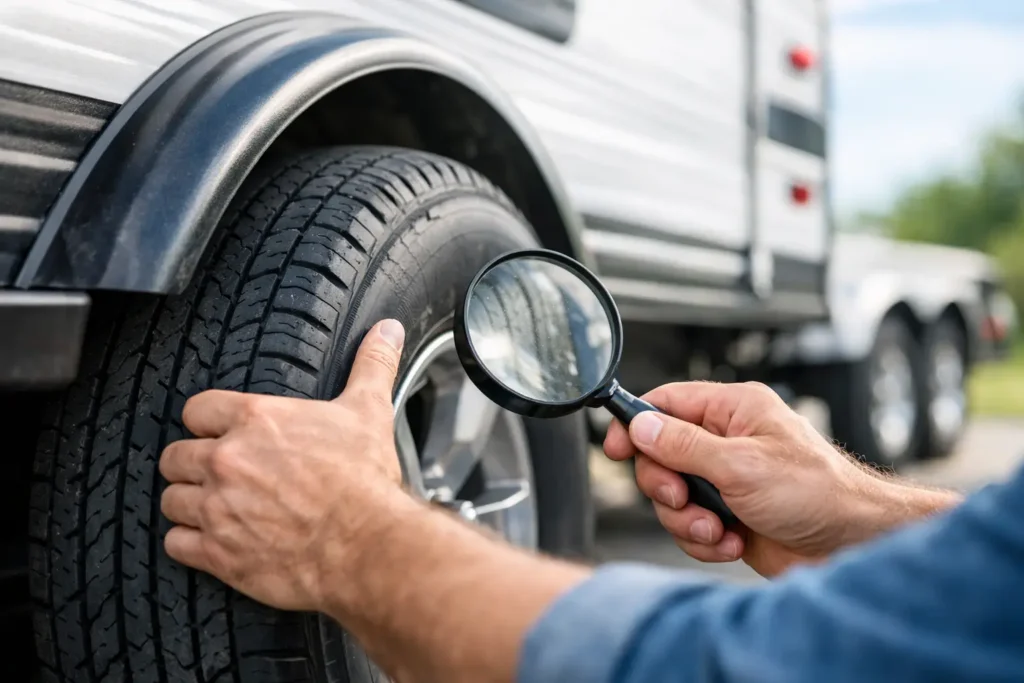
A trailer tire can look fine in the driveway and still be too old to trust at highway speed. That catches a lot of owners off guard, especially if the trailer does not get driven every week. If you are wondering how to check trailer tire age, the answer starts with the DOT date code on the tire sidewall – and that one small number can tell you a lot about your safety.
Trailer tires age differently than many drivers expect. They often sit for long stretches, carry heavy loads, and spend plenty of time in the sun. That means tread depth alone is not enough. A trailer tire can have decent-looking tread and still be living on borrowed time.
If you are looking at your trailer tires and are not sure what you are seeing, it helps to get a second set of eyes before you tow. Just tap the blue phone call button in the lower left corner – we’re just a call away.
How to Check Trailer Tire Age on the Sidewall
The quickest way to check tire age is to find the DOT number stamped into the sidewall. DOT stands for Department of Transportation. Near the end of that code, you will see a four-digit date stamp on tires made in the last couple decades.
Those four digits tell you the week and year the tire was built. If the code ends in 2321, that means the tire was manufactured in the 23rd week of 2021. If it ends in 0819, that means the 8th week of 2019.
On many trailer tires, the full DOT code appears on only one side. So if you do not see the four-digit date on the outward-facing sidewall, check the inside sidewall. Sometimes the date is there and simply not visible until the trailer is moved or the tire is inspected more closely.
Where People Get Tripped Up
A common mistake is reading other sidewall numbers and assuming they show the tire’s age. Load range, tire size, speed rating, and model markings are all important, but they do not tell you when the tire was made. The only date that matters for age is the DOT date code.
Another issue is dirt, weathering, or cramped trailer wheel wells that make the code hard to read. A flashlight and a quick wipe with a rag usually help. If the code is too worn to read clearly, that by itself is a warning sign. When you cannot verify age, it is smart to treat the tire with caution.
How Old Is Too Old for Trailer Tires?
This is where things depend on use, storage, and condition. There is no single answer that fits every trailer, but age matters even when mileage is low. Many trailer owners are surprised to learn that a lightly used tire can still need replacement based on time, not tread wear.
As a practical rule, once trailer tires get around 5 to 6 years old, they deserve a closer look and a more cautious mindset. By 7 years, many owners choose replacement even if the tread still looks usable. Some manufacturers set their own recommendations, and those should always carry weight, but in real-world shop conversations, age past that 5- to 6-year mark is where risk starts becoming harder to ignore.
That is especially true for trailers that sit outside through Minnesota temperature swings. Heat, UV exposure, moisture, and long periods parked under load all work against tire life. A trailer stored indoors and maintained carefully may age better than one parked in the sun year-round, but old rubber is still old rubber.
Signs an Older Trailer Tire Is Drying Out
Age is the starting point, but condition matters too. Fine cracking in the sidewall or between tread blocks is one of the biggest red flags. Bulges, uneven wear, repeated air loss, and a rough or chalky-looking sidewall also point to a tire that may be past its safe service life.
What makes trailer tires tricky is that the warning signs are not always dramatic. Some fail with very little visible tread wear. That is one reason experienced shops take age seriously, not just appearance.
If you see cracking, do not assume a little weather checking is harmless. Sometimes light cracking stays cosmetic for a while. Sometimes it is the early sign of a tire that is drying out and losing structural strength. When a trailer tire lets go, it can damage the trailer, the fender, the wiring, or the cargo before you even get safely off the road.
Why Trailer Tires Age Faster Than People Think
Trailer tires live a different life than passenger car tires. They often carry near-max loads, sit still for long periods, and then get asked to run at highway speed with little warm-up. That stop-and-sit pattern is hard on rubber compounds.
There is also the issue of inflation. Underinflation creates heat, and heat is one of the biggest tire killers. Even a newer trailer tire can age badly if it spends too much time low on air. Overloading adds even more stress.
This is also why tire type matters. Tread design is not the main topic here, but good tire selection still plays a role in safety and control. At Joe’s All Tire, we often emphasize open shoulder tire designs on many vehicle applications because they can improve traction in heavy rain and winter conditions, which matters a lot around Minnesota. If you want to learn more about tread design and seasonal tire choices, our tire knowledge center covers the basics in plain language.
What to Do if the Date Codes Are Different
It is not unusual to find one trailer tire that is newer than the others. Maybe one was replaced after a flat or road hazard. That is not automatically a problem, but it is worth paying attention to.
If one tire is much newer and the others are pushing 6 or 7 years old, the older set may be the weak link. On a tandem-axle trailer especially, one aged tire failure can create a chain reaction of stress on the remaining tires. Matching age, size, load rating, and overall condition usually gives you a more dependable setup.
Spare Tires Count Too
A lot of trailer spares get ignored because they have never touched the road. But the spare tire still ages, even if it has never carried the trailer for a single mile. Sun, weather, and time affect it the same way.
That means your unused spare may already be too old to trust. If you check the main tires, check the spare at the same time. It is better to find out now than on the shoulder of the road when you actually need it.
A Quick Inspection Before Towing
Before any longer trip, check the DOT dates, tire pressure, visible cracking, tread wear, and overall condition. Also make sure the tires are the correct trailer type and load range for the job. This is one of those areas where guessing is expensive.
If the trailer has been sitting for months, give the tires extra attention. A short local pull to the gas station does not put the same demands on a tire as an hour at highway speed in summer heat. Age that seemed easy to ignore around town can become a real problem on the road.
When It Makes Sense to Replace Instead of Risk It
If your trailer tires are aging out, replacement is usually cheaper than the damage from a blowout. That is not scare talk. It is just the math. One failed tire can tear up the trailer body, rip out wiring, ruin a trip, and leave you dealing with roadside repairs at the worst possible time.
At All Tire, this is the kind of call we try to make honestly. If a tire still has life left, that is what you should be told. If it is old enough that you are taking a gamble every time you tow, that should be said clearly too. Most people are not looking for a sales pitch. They want straight advice and work done right the first time.
Checking trailer tire age only takes a few minutes, but it is one of the most useful safety checks you can do before towing. Find the DOT code, read the four-digit date, look hard at the condition, and do not let good-looking tread talk you into trusting old rubber. When a trailer is carrying your equipment, your boat, your camper, or your family plans for the weekend, a tire’s birthday matters more than most people think.
