

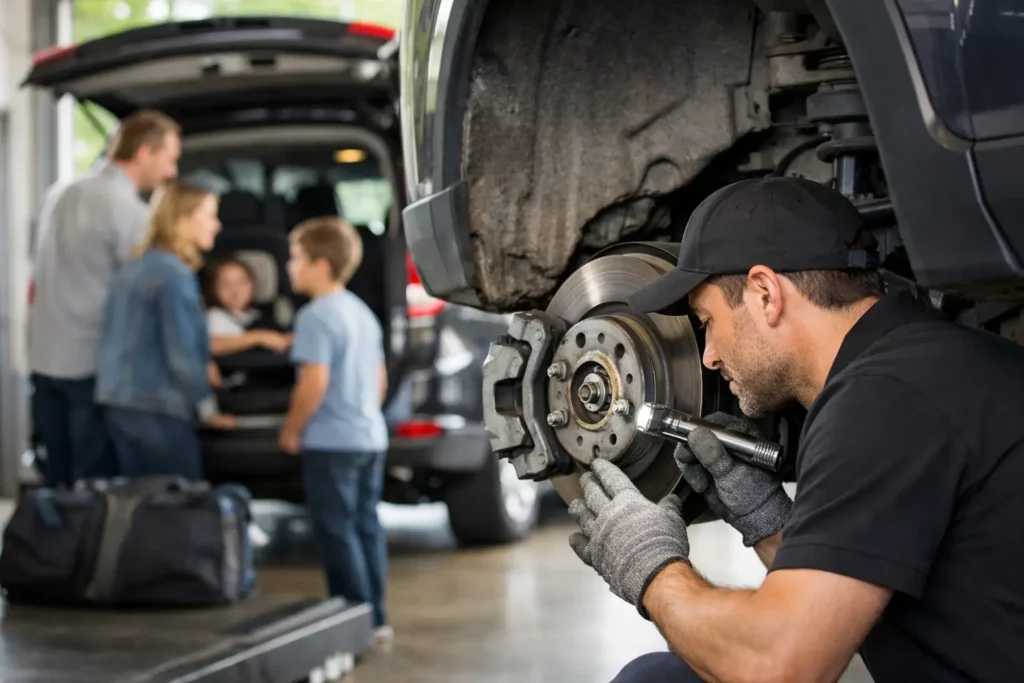
School drop-offs, grocery runs, hockey bags, wet roads, icy mornings – family vehicles put in real work. A good family vehicle brake safety checklist helps you catch small warning signs before they turn into a longer stopping distance, a damaged rotor, or a situation where your car just doesn’t feel safe with your kids in the back.
For most families, brake problems don’t show up all at once. They creep in. Maybe the pedal feels softer than it used to. Maybe there’s a squeal backing out of the driveway. Maybe the vehicle starts pulling a little when you stop at a light. Those changes matter, especially in Minnesota where rain, slush, road salt, and winter driving put more stress on the whole vehicle.
Why a family vehicle brake safety checklist matters
Brakes aren’t just another maintenance item. They’re the system you count on when traffic stops fast, a deer jumps out, or a snowy intersection turns slick. On a family vehicle, that matters even more because the load is often heavier. More passengers, cargo, sports gear, and everyday driving all add up.
Brake wear also doesn’t happen in a perfectly even way. Front brakes usually wear faster, but driving habits, road conditions, towing, and vehicle design all affect the pattern. That’s why a simple checklist is useful. It gives you a way to notice what your vehicle is telling you before the problem gets expensive.
Your family vehicle brake safety checklist
1. Listen for new sounds
A brake squeal isn’t always an emergency, but it should never be ignored. Some pads have wear indicators designed to make noise when they’re getting low. Grinding is more serious. That can mean the friction material is gone and metal is contacting metal.
If you hear noise only first thing in the morning, and it goes away quickly, moisture or surface rust may be part of it. If the sound keeps happening, gets louder, or shows up every time you stop, it’s time to have it checked.
2. Pay attention to pedal feel
Your brake pedal should feel firm and predictable. If it suddenly feels soft, sinks lower than normal, or takes more effort to stop, something’s changed. That can point to worn brake parts, fluid issues, air in the system, or a hydraulic problem.
This is one of those areas where guessing isn’t worth it. If you’re noticing a pedal that doesn’t feel right and want a straight answer before it turns into a bigger repair, just tap the blue phone call button in the lower left corner – we’re just a call away.
3. Notice pulling or uneven stopping
If the vehicle pulls left or right when braking, don’t brush it off as road crown or wind. It may be uneven brake force, a sticking caliper, worn suspension parts, or tire-related issues affecting stability under braking.
That’s where experience matters. At Joe’s All Tire, or All Tire as a lot of locals call us, we look at the whole picture instead of forcing a one-size-fits-all brake sale. Sometimes it is the brakes. Sometimes it’s a tire, wheel bearing, or front-end issue showing up when you stop.
4. Watch for vibration
A vibration in the steering wheel or brake pedal while stopping often points to rotor issues, but not always. It can also be tied to wheel, tire, or suspension conditions. If the vibration only happens during braking, the brake system moves higher on the suspect list.
The key is not to assume. A chain store might jump straight to parts replacement. We prefer diagnosing the actual cause first. That’s how you avoid paying for work that doesn’t solve the problem.
5. Check brake fluid condition and level
You don’t need to be a technician to glance at the brake fluid reservoir. If the level is low, or the fluid looks very dark or dirty, it’s worth attention. Low fluid can be linked to brake wear, but it can also point to a leak or another issue.
Don’t top it off blindly and call it good. Brake fluid condition matters, and so does figuring out why the level changed in the first place. Proper repair beats a shortcut every time.
6. Look at pad thickness if visible
On some vehicles, you can see the outer brake pad through the wheel openings. If the pad material looks very thin, that’s a warning sign. Not every wheel design makes this easy, and you still can’t see the full brake condition from one quick glance, but it can help you catch obvious wear.
A visual check is useful, just not complete. Inner and outer pads don’t always wear the same, and rotors can have issues you won’t spot from the driveway.
7. Think about stopping distance
If your vehicle seems to need more room to stop than it used to, trust that instinct. Families get used to their vehicle’s normal feel. When that changes, there is usually a reason.
Sometimes the cause is brake wear. Sometimes it’s tire traction. In Minnesota, tire condition matters a lot because braking performance depends on the tires gripping the road. That’s one reason we strongly recommend open shoulder tires for many cars and trucks – they help with summer rain evacuation and winter traction, which can make a real difference when you need to stop fast.
8. Don’t ignore the brake warning light or ABS light
Dash lights are there for a reason. A brake warning light may signal low fluid, a hydraulic issue, or a parking brake problem. An ABS light means the anti-lock system may not function as designed in a hard stop.
The vehicle may still drive, but your emergency braking performance may not be what you expect. That’s not something to put off if you regularly carry kids, commute daily, or drive in snow and ice.
What changes brake wear on a family vehicle
Not all families wear brakes at the same rate. Short trips can be surprisingly hard on brake systems because the vehicle never really settles into highway driving. Stop-and-go traffic, school pickup lines, hills, towing a trailer, and carrying heavier loads all speed things up.
Weather matters too. Around Elk River and the surrounding area, winter road treatment and slushy conditions can add corrosion into the equation. That doesn’t just affect rotors. It can affect hardware, caliper movement, and how evenly the brakes wear over time.
Driving style also plays a role, but this isn’t about blame. Some drivers coast more. Some brake later. Some routes are just tougher on vehicles. The smart move is routine inspection, not trying to guess a perfect mileage number.
When a quick driveway check isn’t enough
A family vehicle brake safety checklist is meant to help you spot warning signs early. It’s not a replacement for a proper inspection. Once there’s noise, pulling, fluid loss, warning lights, vibration, or reduced stopping confidence, the next step should be a real look by someone who knows what they’re seeing.
That matters because brake issues can overlap with tire and suspension issues. If your tires are worn, mismatched, or not suited for Minnesota roads, braking performance suffers even if the brake hardware is still decent. This Isn’t Walmart. Cheap parts, rushed service, and vague answers aren’t what keep families safe.
What people usually want is simple: honest advice, clear options, and the repair done right the first time. That’s the difference owner-led local shops still bring to the table.
How often should you check your brakes?
A quick awareness check can happen every week without much effort. Listen when you back out of the driveway. Notice how the pedal feels on the way to work. Pay attention if the vehicle starts stopping differently.
A more deliberate check makes sense before a road trip, before winter sets in, and any time you notice a change. If you’re already coming in for tires, rotation, vibration concerns, or seasonal maintenance, that’s a smart time to ask about brake condition too.
And because tires and braking work together, it’s worth learning more about tread design and seasonal traction if you’re comparing replacement options for your family vehicle. Our knowledge center covers the basics in plain language at www.joesalltire.com/knowledge-center/.
A safer routine for busy families
Most brake failures don’t come out of nowhere. There were signs. A sound that got ignored. A pull that kept getting worse. A warning light that stayed on for three weeks because life got busy. That’s normal life, but it’s also why having a checklist helps.
If your family vehicle is giving you any reason to question how it stops, trust that feeling and get it checked. Peace of mind isn’t fancy, but when the roads are wet, icy, or packed with traffic, it counts for a lot.
