

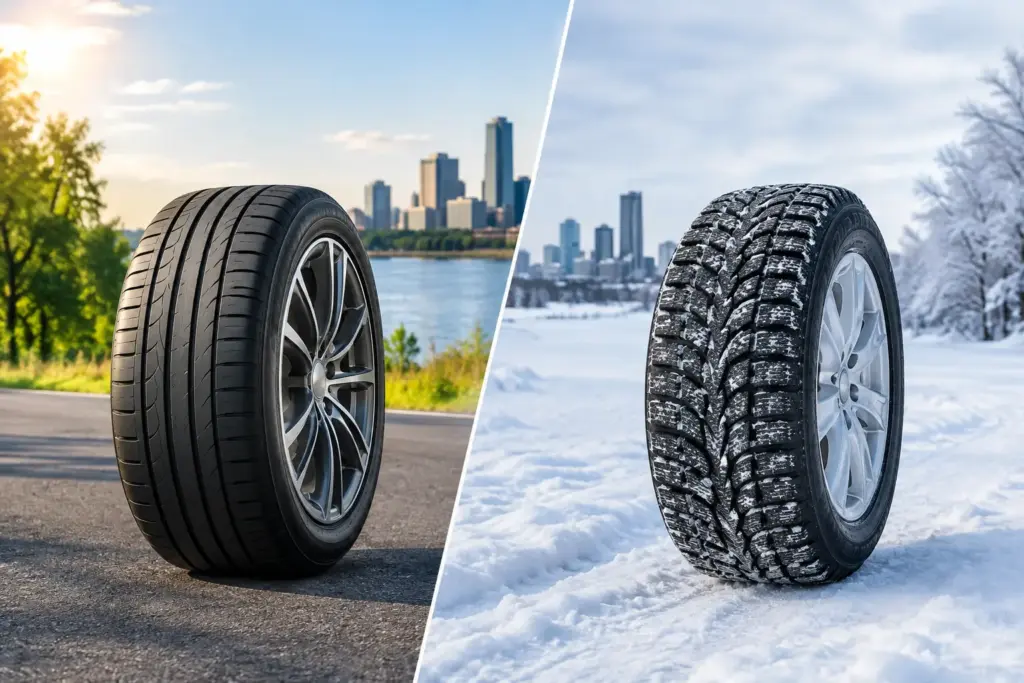
A Minnesota road can be dry at lunchtime, soaked by a cold rain at 4 p.m., and glazed with ice before the morning commute. That’s why summer tires vs winter tires isn’t just a comparison for tire enthusiasts. It’s a real safety decision for families, commuters, pickup owners, and anyone who needs to get home without white-knuckling the drive.
At Joe’s All Tire, locals know us as ALL TIRE, and we see what changing seasons do to tires every day. The right answer depends on when, where, and how you drive. But for most Elk River-area drivers, a true winter tire is the safer choice once consistent cold, snow, and ice arrive.
Summer Tires vs Winter Tires: The Real Difference
The main difference isn’t simply how deep the tread looks. Summer and winter tires are built with different rubber compounds and tread patterns for completely different temperature ranges.
Summer tires use a firmer rubber compound designed to stay stable in warm weather. That firmness helps the tire respond quickly to steering input, hold its shape in corners, and maintain confident contact with dry pavement. Many summer tires also handle warm, wet roads very well because their tread channels move water away from the contact patch.
Winter tires use a softer compound that stays flexible when temperatures drop. When rubber gets too hard in the cold, it can’t grip the tiny irregularities in pavement, packed snow, or ice as effectively. Winter tread also includes thousands of small biting edges, called sipes, that help the tire grab slippery surfaces as it rolls.
A summer tire may feel sharp and planted in July. In a Minnesota December, that same tire can become noticeably less cooperative even before snow starts falling.
Why Temperature Matters More Than the Calendar
A lot of drivers wait for the first major snowfall before thinking about tires. That’s understandable, but cold-weather grip starts changing long before the roads turn white.
When daytime highs regularly sit around 45 degrees or below, summer tire rubber begins to lose much of the flexibility it needs. Braking distances can increase, acceleration gets less secure, and turns demand more care. A clear, cold road can still be a problem if your tires aren’t designed for it.
Winter tires aren’t only for deep snow. They’re made for the cold pavement, slush, black ice, and packed intersections that make Minnesota driving unpredictable for roughly five months each year.
If you’re deciding whether your current tires can get you through another season, it helps to have someone look at the tread depth, tire age, wear pattern, and overall condition. Joe at ALL TIRE can give you a straight answer based on your vehicle and driving habits. If you want to talk through your options or schedule a check, mobile visitors can tap the blue call button in the lower left corner – we’re just a call away.
Open Shoulder Tread Designs Matter in Rain and Snow
Tread design deserves more attention than the label on the sidewall. ALL TIRE strongly recommends open shoulder tire designs for cars and trucks whenever the application allows. An open shoulder has wider channels around the outer edges of the tread, giving water, slush, and loose snow a place to go instead of building up under the tire.
That matters on summer rain-soaked highways, where standing water can reduce traction quickly. It matters again in winter, when slush and snow need to clear from the tread so the tire can keep finding the road beneath it.
Open shoulders don’t turn an all-season tire into a dedicated winter tire, and they can’t replace careful driving. They do give a tire a better chance to evacuate water and snow, which is a meaningful advantage in the conditions Minnesota drivers actually face.
When comparing options, look beyond an aggressive-looking tread. The right tire needs to match your vehicle, load needs, road conditions, and the kind of driving you do most often. A pickup used for highway commuting needs something different from a truck that regularly pulls a trailer or drives rural gravel roads.
Where All-Season and M&S Tires Fit In
All-season tires are a practical middle ground for many drivers. They’re designed to handle a broad range of conditions, including light snow, rain, and dry pavement. A tire marked M&S (Mud & Snow) meets an industry tread-design standard, but that marking alone doesn’t mean it performs like a dedicated winter tire on ice or in severe cold.
For drivers who stay close to home, avoid storms when possible, and have reasonable winter road maintenance, a quality all-season tire with an open shoulder design may be a sensible year-round choice. It can also save the cost and storage question of running two sets of tires.
The trade-off is simple: all-season tires do many things adequately, while dedicated summer and winter tires are built to do specific jobs exceptionally well. If you commute early, drive long distances no matter the forecast, carry kids, or travel roads that may not be cleared right away, winter tires offer a more valuable safety margin.
When Summer Tires Make Sense
Summer tires make sense for vehicles driven mainly in warm weather, performance-oriented cars, and drivers who value responsive handling and braking on dry or wet pavement. They’re especially useful when temperatures stay consistently warm and there’s no chance of snow or ice.
They’re not a good fit for a Minnesota vehicle that must be driven through winter. Even if the tread still looks healthy, the compound and siping are working against you once real cold sets in.
If you have a second vehicle that stays parked through winter, summer tires can be a great setup. Otherwise, plan your seasonal changeover before the weather forces the issue. Waiting until the first storm often means trying to make a tire decision when everyone else is doing the same thing.
When Winter Tires Are Worth It
Winter tires are worth serious consideration if any of these situations sound familiar:
- You commute before roads are fully plowed or treated.
- Your route includes rural roads, hills, bridges, or shaded areas that ice over.
- You regularly drive children, older family members, or passengers who depend on you.
- You drive a rear-wheel-drive truck, a front-wheel-drive car, or an all-wheel-drive vehicle that still needs help stopping and turning on ice.
That last point catches people off guard. All-wheel drive can help you get moving, but it doesn’t give your vehicle the same advantage when braking or cornering. Tires are the only part of the vehicle that touches the road. Four driven wheels don’t change that.
A dedicated winter set also protects your summer or all-season tires from winter wear. Over time, running two seasonal sets can spread the miles across both sets, though you’ll need to account for seasonal mounting, balancing, and storage.
Don’t Let Price Be the Only Deciding Factor
A low upfront price can be tempting, especially when tires aren’t in the budget. But a tire’s real value includes wet traction, cold-weather grip, expected tread life, ride quality, warranty support, and whether it’s properly mounted and balanced.
“This Isn’t Walmart” isn’t about making a purchase complicated. It means you should get more than a box-store transaction when your family’s safety is riding on four contact patches. At ALL TIRE, the focus is on matching the tire to the job, explaining the trade-offs clearly, and installing it correctly the first time.
Proper installation matters just as much as the tire choice. Correct balancing helps prevent vibration, accurate air pressure supports handling and tread life, and a TPMS warning should be diagnosed instead of ignored. If a vehicle pulls, shakes, or wears tires unevenly, it may also be pointing to an alignment, suspension, or wheel bearing issue.
Frequently Asked Questions
Can I use summer tires in light snow?
You can, but it’s not recommended. Even light snow becomes risky when temperatures are low because summer tire rubber stiffens and loses grip. The problem is often stopping and turning, not just getting moving.
Are winter tires only needed for deep snow?
No. Winter tires help on cold dry pavement, wet freezing roads, packed snow, slush, and ice. Their softer compound and extra biting edges are useful throughout a Minnesota winter.
Are M&S tires the same as winter tires?
No. M&S indicates a tread-design classification, while a dedicated winter tire is engineered and tested for severe snow performance and low-temperature flexibility. Some all-season tires carry M&S markings but won’t match true winter tire traction.
Do I need winter tires on all four wheels?
Yes. Installing winter tires on all four corners gives your vehicle balanced braking, cornering, and acceleration. Mixing only two winter tires with two non-winter tires can create unpredictable handling in slippery conditions.
When should I switch back from winter tires?
Switch back when temperatures are consistently warmer, usually in spring after the threat of sustained freezing conditions has passed. Winter tires wear faster in warm weather, so don’t leave them on through the heat of summer. If you’re unsure what makes sense for your vehicle, a quick, honest inspection now can save you from a stressful decision on the first slippery morning.