
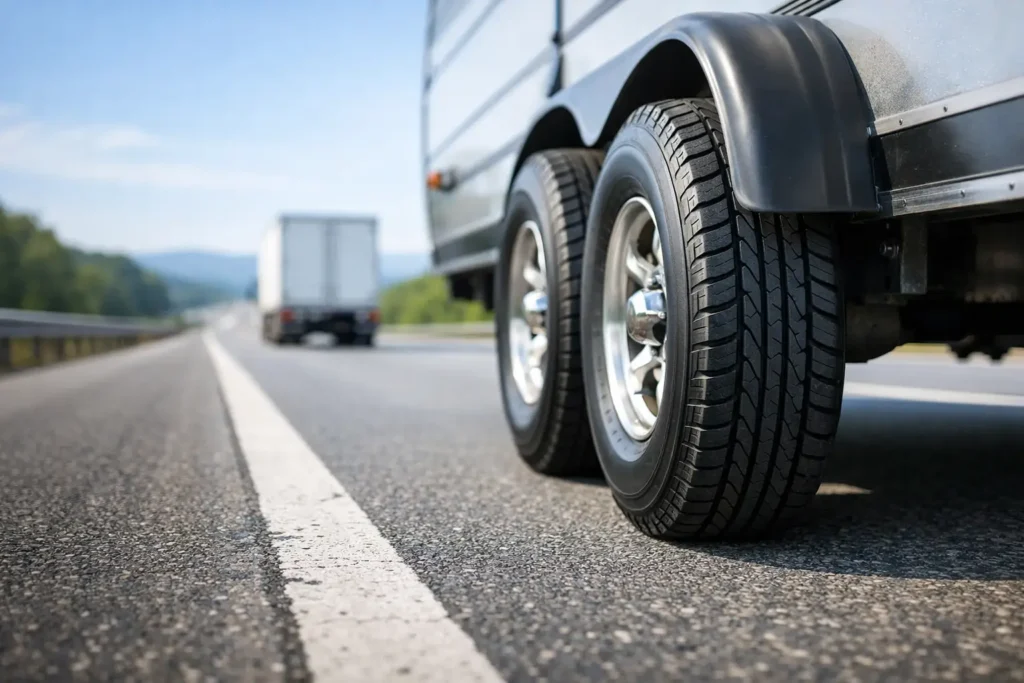
A trailer tire usually gives you plenty of warning only after it has already started failing. You feel a wiggle, see uneven wear, or end up on the shoulder with shredded rubber wrapped around the axle. That is why choosing the best trailer tires for highway use is less about brand hype and more about getting the right construction, load range, and operating margin for the way you tow.
If you are trying to sort through options and are not sure what actually fits your trailer, load, and travel habits, getting a second opinion can save you money and headaches. Just tap the blue phone call button in the lower left corner – we’re just a call away.
What makes the best trailer tires for highway use?
Highway towing is hard on tires in a different way than local hauling. A trailer tire may sit for stretches, then suddenly spend hours at steady speed under a full load in hot weather. That combination of weight, heat, and time is what separates a decent trailer tire from one that holds up.
The best trailer tires for highway use usually have four things working in your favor. First, they are true trailer tires, marked ST, which means Special Trailer. Second, they have enough load capacity that you are not running close to the limit every trip. Third, they are rated for the speeds you actually drive. Fourth, they are built to control heat, because heat is what kills trailer tires.
A lot of drivers focus only on tread. Tread matters, but on a trailer, the internal build is often the bigger story. Sidewall strength, belt package, and load range are what keep the tire stable and reduce sway when the trailer starts reacting to wind, road grooves, or emergency maneuvers.
ST tires vs LT tires on a trailer
This is one of the most common points of confusion. In many cases, an ST tire is the better fit because it is designed specifically for trailer service. It usually has a stiffer sidewall to manage trailer sway and heavy vertical loads. That makes it a strong choice for utility trailers, enclosed trailers, campers, and many boat trailers.
An LT tire, or Light Truck tire, can make sense in some trailer applications, but only if the trailer manufacturer allows it and the tire has the correct capacity. Some heavier equipment trailers or custom setups may use LT tires successfully. Still, this is not a shortcut. You do not want to swap tire types without checking wheel rating, clearance, and actual axle weight.
For most everyday owners, the safer rule is simple: stay with the trailer tire type the trailer was designed around unless an experienced tire professional tells you otherwise.
Load range matters more than most people think
A trailer tire can look fine and still be undersized for highway work. That is where load range comes in. Load range is not just a letter on the sidewall. It tells you how much weight the tire can carry at a specified pressure.
If your trailer has two 3,500-pound axles, that does not automatically mean any tire that technically covers the math is a good choice. Real-world towing adds heat, potholes, side loads in turns, and weight shifts from cargo placement. Running too close to the tire’s maximum capacity leaves very little cushion.
That is why many experienced shops prefer a healthy safety margin. If your trailer is frequently near its gross weight rating, choosing a stronger load range can be the difference between a tire that survives summer highway miles and one that starts breaking down internally.
You also need to make sure the wheel itself is rated for the air pressure required by that tire. Upgrading the tire without confirming the wheel rating is a mistake people make more often than they realize.
Speed rating is not a small detail
Years ago, many trailer tires had lower speed limitations than drivers expected. That has improved, but the problem has not disappeared. Some trailer owners assume that because traffic is moving at 75 mph, their trailer tires are happy there too. That is not always true.
The best trailer tires for highway use should match the speeds you actually tow, not the speeds you wish you drove. If you regularly pull a camper on long interstate trips, your tire choice needs to reflect that. A tire that is running near its load limit at higher speed in summer heat is under real stress.
Even with a higher speed-rated tire, good towing habits still matter. Proper inflation, balanced loading, and not pushing speed unnecessarily all help reduce heat buildup.
Radial vs bias-ply for highway towing
For most highway use, radial trailer tires are the clear winner. They generally run cooler, track better at sustained speed, and wear more evenly on longer trips. If your trailer spends most of its time on pavement, radial is usually the practical choice.
Bias-ply tires still have a place. They can be useful on certain utility or off-road trailers that see rough surfaces, sharp turns in tight yards, or lower-speed use. They often have tougher sidewall behavior in those conditions. But for regular interstate or state highway travel, most drivers will be better served by a quality radial ST tire.
Tread pattern still matters, just differently
Trailer tires are not drive tires, so the tread conversation is a little different than it is for cars and trucks. You are not looking for aggressive traction in the same way. You are looking for stability, water evacuation, and even wear.
At Joe’s All Tire, we often talk about open shoulder tread designs on vehicle tires because they help with summer rain and winter traction, especially in Minnesota conditions. On trailers, the priorities shift more toward highway stability and heat management, but tread design still plays a role in wet-weather control. If you want to understand more about how tire design affects performance, the tire knowledge center at www.joesalltire.com/knowledge-center/ is a helpful place to start.
In general, avoid buying a trailer tire just because the tread looks impressive. A dramatic-looking pattern does not guarantee better highway durability. The right tire is the one with the right load rating, proper build quality, and a tread design that clears water without sacrificing stability.
Common mistakes that shorten trailer tire life
A lot of trailer tire failures start long before the blowout. Underinflation is one of the biggest causes. A trailer tire that is even a little low can run hotter than you think, especially on a loaded highway trip. Unlike some passenger tires, trailer tires usually need to be run at the pressure required to carry their rated load.
Age is another problem. Trailer tires often age out before they wear out. Sun, storage, sitting in one place, and seasonal use all take a toll. A tire with good tread depth can still be a bad highway candidate if the rubber is aging and the internal structure is deteriorating.
Poor balancing, bent wheels, worn suspension parts, and bad wheel bearings can also ruin a good set of tires. If you are seeing unusual wear or feeling vibration through the tow vehicle, replacing tires without checking the rest of the trailer can leave the real issue untouched.
How to choose the right trailer tire for your setup
Start with the trailer placard and the current tire size. Then verify your actual use. A small lawn trailer used around town needs something different than an enclosed cargo trailer that runs at highway speed every weekend. A boat trailer has different moisture and storage concerns than a camper parked half the year.
Be honest about weight too. If you routinely haul near max capacity, say so. If the trailer sits for long periods, that matters. If you are planning longer summer road trips, that matters too. The best choice depends on more than sidewall size.
This is where a local shop can help more than a generic online fitment tool. A real conversation about how you use the trailer often catches problems a screen never will.
When it makes sense to replace all trailer tires at once
If one tire failed because of impact damage, replacing one may be enough. But if the set is aging, worn unevenly, or all from the same production period, replacing only the bad one can be shortsighted. Trailer tires tend to live hard lives together.
Matching construction, age, and load capability across the axle helps the trailer track more consistently. It also reduces the chance that the next weakest tire fails right after you replace the first one.
Around Elk River, a lot of trailer owners use their equipment seasonally, which makes age-related replacement especially common. Tires can look decent after sitting through months of weather changes and still not be trustworthy for a highway run.
The best trailer tires for highway use are the ones that fit your trailer correctly, carry the load with room to spare, handle your towing speed, and are kept at the right pressure. That answer is not flashy, but it is the kind that keeps you rolling straight instead of standing beside the road with a damaged fender and a ruined trip.