

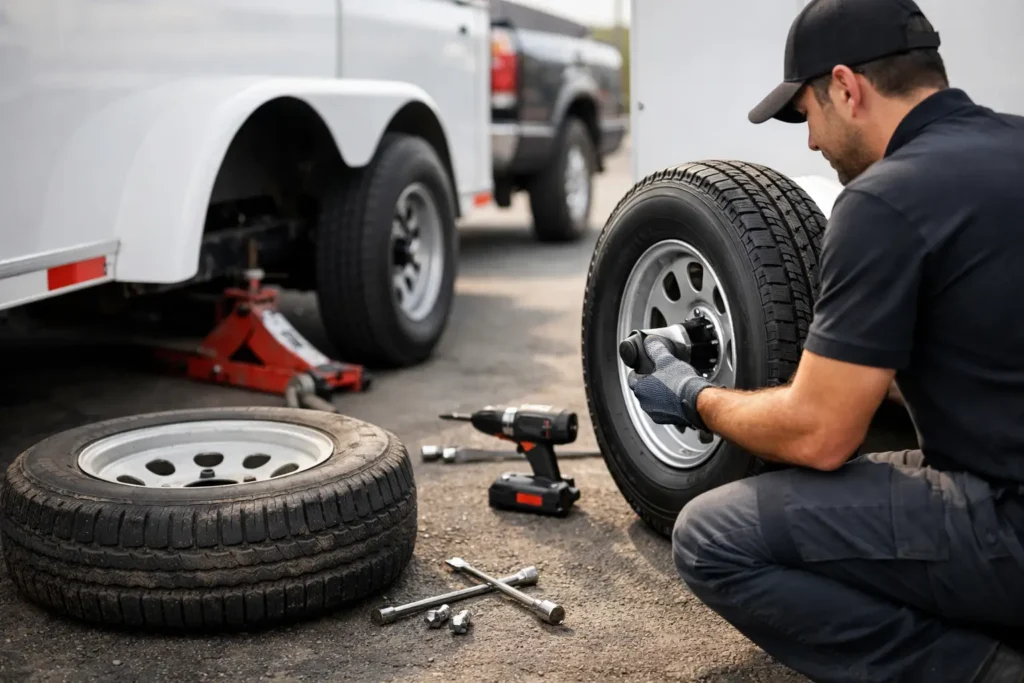
A trailer tire usually waits until the worst possible moment to fail. It happens on the way to the cabin, halfway to the jobsite, or just after you merge onto the highway with a full load behind you. That is why trailer tire replacement service is not something to put off once you see cracking, uneven wear, or repeated air loss.
Trailer tires work harder than a lot of people realize. They do not steer, and they are often out of sight, so problems can build up quietly. By the time a trailer starts bouncing, swaying, or wearing one edge faster than the other, the tire may already be well past the point of safe use.
When trailer tire replacement service is the safer call
A repair makes sense in some cases, but not every trailer tire should be repaired. If the tread is worn down, the casing is aging out, or the damage is in the sidewall, replacement is the right move. A good shop should tell you that plainly.
Trailer tires age differently than passenger tires. Many trailers sit for stretches, then carry a lot of weight for a weekend or a work run. That stop-and-go life can be hard on the rubber. Sun exposure, temperature swings, and underinflation all speed up cracking and internal breakdown. In Minnesota, that matters even more. Long cold seasons and spring potholes are rough on any tire, and trailer tires do not get a free pass.
There are a few signs that usually point toward replacement instead of repair. One is visible weather checking or dry rot on the sidewall. Another is tread separation, bulging, or any impact damage from curbs or road debris. If a tire has worn unevenly because of a bent axle, bearing issue, or chronic underinflation, just swapping in another tire without fixing the root problem can leave you right back where you started.
What a proper trailer tire replacement service should include
A lot of people think replacing a trailer tire means pulling off the old one and installing a new one. That is only part of the job. Done right, the service should include inspection of the wheel, valve stem, tire condition on the opposite side, and the wear pattern that tells the story.
Mounting and balancing matter more than some trailer owners expect. Not every trailer setup needs the exact same approach, but balance can help reduce vibration, protect suspension parts, and improve tire life. If a trailer bounces or shakes on the road, the issue may not be the tire alone. Wheel bearings, bent components, or load distribution may be part of it.
A trustworthy shop will also confirm that the replacement tire matches the trailer’s needs. Load capacity, tire size, inflation requirements, and speed rating all need to line up with how the trailer is actually used. A lightly used utility trailer is one thing. A tandem-axle trailer hauling equipment or a camper heading out at highway speeds is another.
That is where experience matters. This is not a place for guesswork or the cheapest option on the shelf if it is the wrong fit.
Choosing the right replacement tire for your trailer
The right tire starts with the trailer’s specifications, but real-world use matters too. You want enough load capacity with a margin that makes sense, not a tire that is technically acceptable on paper and stressed every trip.
Trailer owners also need to understand the difference between tire categories. A dedicated trailer tire is built for trailer service, with sidewall construction and load characteristics suited to carrying weight and handling sway differently than a passenger or light truck tire. There are exceptions depending on the trailer and application, but in general, matching the tire to the job is the safer route.
Tread design can play a role as well. For vehicles in Minnesota, we strongly recommend open shoulder tire designs on cars and trucks for improved winter traction during our long snow and ice season. If you want to learn more about tread design and seasonal tire performance, our tire knowledge center is a good place to start. For trailers, the conversation is a little different. The key is stable load support, proper construction, and a tread pattern suited to the conditions the trailer actually sees. A trailer that mostly runs dry pavement has different needs than one pulled on gravel roads, muddy lots, or rough seasonal roads.
Why trailer tires fail sooner than people expect
The most common cause is underinflation. Even a tire that looks close to full can be running below spec, and that creates heat. Heat is what kills trailer tires. Once excess heat builds up, the structure of the tire starts to break down. That can lead to blowouts, belt separation, and rapid wear.
Overloading is another big one. Sometimes the trailer is overloaded. Other times the cargo is legal enough in total weight but distributed poorly, which puts too much stress on one axle or one side. A brand-new tire will not fix a load problem.
Age is the quiet factor. Plenty of trailer tires wear out by time before they wear out by tread depth. If a trailer spends a lot of time parked outside, the rubber can harden and crack long before the tread looks used up. That is why visual inspection matters more than mileage alone.
Then there are mechanical problems. Bad alignment, worn suspension parts, and failing wheel bearings can all eat up a trailer tire in a hurry. If one tire keeps wearing on the inside or outside edge, there is usually a reason. Replacing the tire without addressing that cause is only a short-term fix.
Trailer tire replacement service vs roadside emergency replacement
There is a big difference between planned replacement and emergency replacement on the shoulder. When you replace a worn tire before it fails, you have time to choose the right tire, inspect the wheel assembly, and make sure the trailer is road-ready. When a tire comes apart on the highway, you may also be dealing with fender damage, wiring damage, or a wheel that took a hit.
That is one reason many trailer owners replace tires in pairs, especially on the same axle. It is not always mandatory, but it is often smart. If one tire is aged out and the other was installed at the same time, the second one is usually not far behind. Matching tread and construction side to side can also help with predictable handling and wear.
What local trailer owners should ask before replacing tires
Ask whether the tire is the correct load range for your trailer. Ask whether the wheel and valve stem are in good shape. Ask whether the wear pattern suggests a bearing, alignment, or suspension issue. And ask how old the remaining tires are, even if they still have tread.
A good answer should be simple and direct. You should not need a sales pitch to understand what your trailer needs.
If you use your trailer seasonally, it also helps to ask about storage habits and pressure checks. A trailer parked all winter and pulled hard in spring is a common setup around Elk River and surrounding communities. That first trip of the season is when neglected tires often show their age.
Why workmanship matters on trailer tires
Trailer tire work is safety work. The right torque, proper inflation, clean mounting surfaces, and careful inspection all matter. A trailer tire that is installed carelessly can cause vibration, loosen hardware, or fail early for reasons that had nothing to do with the tire itself.
That is where a local shop can make a real difference. At Joe’s All Tire, the focus is on honest advice and getting the job done right the first time. That means looking beyond the obvious flat or worn tread and paying attention to what caused the problem in the first place.
For everyday trailer owners, that approach saves money over time. More importantly, it helps prevent the kind of roadside trouble that can ruin a workday, a family trip, or a weekend away.
If your trailer tires are showing cracks, wearing unevenly, or simply aging out, do not wait for the highway to make the decision for you. Replacing them at the right time is one of the simplest ways to keep your trailer safe, stable, and ready when you need it.
