

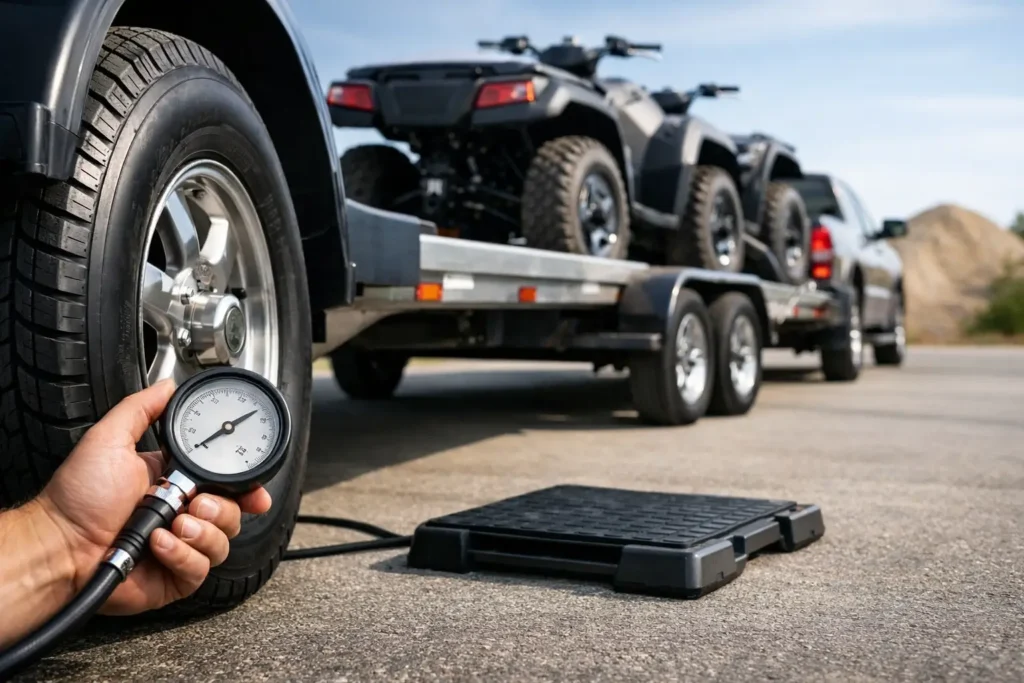
A trailer can look perfectly level in the driveway and still be overloaded on one tire. That’s why trailer tire pressure vs trailer weight isn’t just a matter of putting air in the tires before a weekend trip. The pressure has to support the actual load at each wheel, stay within the tire and wheel ratings, and leave enough safety margin for highway heat, potholes, crosswinds, and Minnesota road conditions.
For a utility trailer, boat trailer, enclosed cargo trailer, or camper, the right answer usually isn’t found by guessing. It comes from the trailer’s certification label, the tire’s load rating, and – when the trailer carries heavier or uneven loads – real scale weights.
Trailer Tire Pressure vs Trailer Weight: The Basic Rule
Tire pressure supports trailer weight, but pressure alone doesn’t tell the whole story. A tire’s load capacity is tied to its size, construction, and inflation pressure. As inflation goes down, the amount of weight that tire can safely carry goes down too. Underinflation also creates extra sidewall flex, and flex creates heat. Heat is one of the fastest ways to shorten trailer tire life or cause a failure.
Start with the trailer manufacturer’s tire and loading label, usually found on the tongue, frame, or inside a storage compartment. It should list the original tire size, recommended cold inflation pressure, and the trailer’s gross vehicle weight rating, or GVWR. That label is the best starting point because it accounts for the trailer as it was built.
The maximum cold pressure stamped on a tire’s sidewall is not a suggestion to exceed every other rating on the trailer. Wheels, valve stems, and the trailer itself all have limits. But many Special Trailer, or ST, tires are designed to deliver their stated maximum load capacity only at the maximum cold pressure printed on the sidewall. If your trailer label calls for that same pressure, follow it.
The key word is cold. Check trailer tires before driving, preferably after the trailer has been parked for several hours and out of direct sun. A pressure increase while driving is normal. Don’t let air out of a hot tire just because the number rose after a few miles.
Why the Trailer’s Total Weight Can Mislead You
A trailer’s total loaded weight is useful, but tires don’t carry weight evenly by default. Tongue weight transfers part of the load to the tow vehicle, so it doesn’t all sit on the trailer axles. On a conventional bumper-pull trailer, tongue weight commonly falls around 10% to 15% of total trailer weight. Fifth-wheel trailers often place a larger share on the truck.
That still doesn’t mean each trailer tire carries an equal portion of what remains. A toolbox mounted on one side, a side-by-side parked slightly off center, a water tank, or cargo stacked against one wall can overload one tire while the others are fine. A tandem-axle trailer can also shift weight between axles during turns, on uneven ground, or when suspension components aren’t working as they should.
Here’s a simple example. Say a loaded trailer weighs 6,000 pounds and has 750 pounds of tongue weight. Roughly 5,250 pounds remains on the trailer axles. With four tires, the simple average is about 1,313 pounds per tire. But that average isn’t a safe operating number if one side is carrying 1,500 pounds per tire and the other side is carrying less.
That’s why weighing the trailer matters when you routinely haul close to capacity. A public scale can establish total trailer and axle weights. Individual wheel weights are even better, especially for enclosed trailers, campers, and work trailers with equipment that stays in the same place.
Trailer tire sidewalls list a maximum load @ maximum pressure, not the pressure to set your tires to
Sidewalls for example may show, 1,850 lbs at 50 PSI on a 6-ply, Load Range C tire. That number represents the pressure needed to carry the tire’s full rated load, not necessarily the pressure you need for every trailer. If your trailer only weighs 2,000 lbs total and rides on a single axle, with the tongue/hitch carrying roughly 10-15% of that weight, the axle is only supporting somewhere around 1,700-1,800 lbs — split across two tires, that’s well under each tire’s 1,850 lb capacity. In that case, running the full 50 PSI isn’t required, and many owners will drop closer to 35 PSI based on the tire manufacturer’s load-inflation chart for that actual per-tire weight. The sidewall itself is actually the first suspension component to absorb bumps and potholes. It’s designed to flex slightly under load as the tire rolls over uneven pavement. Run too much pressure for the actual weight on that axle, and the sidewall becomes overly rigid — instead of flexing, the tire can hop or momentarily leave the road surface when it hits a bump, which reduces traction and control rather than improving it. That said, we always recommend checking the tire maker’s specific load-inflation table rather than estimating, since the relationship between load and pressure isn’t linear — a small drop in PSI can reduce load capacity more than expected. Running pressure too low for the actual load causes excess sidewall flex and heat buildup, which is one of the leading causes of trailer tire failure and blowouts, even more so than overinflation. So while you don’t always need to max out the sidewall PSI, it’s worth having us check your trailer’s actual loaded weight per axle and match that against the tire’s chart, rather than just guessing at a number in between.
Match Tire Capacity to the Heaviest Wheel Position
Once you know what the trailer carries, compare that weight with the tire manufacturer’s load-and-inflation information for your exact tire size and type. Build your pressure and capacity decision around the heaviest-loaded tire position, not the average.
You also need a practical margin. Trailer tires deal with hard service: curb strikes, rough pavement, long stretches of interstate speed, summer heat, and long periods of sitting. Running every tire right at its limit leaves little room for a load shift or a scale error.
If your actual wheel load requires more capacity than the installed tires can provide, adding air beyond the tire or wheel rating is not the answer. You may need a higher-capacity tire and wheel package, a different load range, changes to how cargo is placed, or a trailer that better matches the job. This is one area where honest advice is worth more than a quick guess.
If you’re loading a trailer for the first time, dealing with uneven tire wear, or aren’t sure whether the existing tires are adequate, Joe’s All Tire can help you sort out the numbers and inspect the setup. On a mobile device, tap the blue phone call button in the lower left corner to ask questions or schedule an appointment – we’re just a call away.
Pressure Problems Have Clear Warning Signs
Low pressure doesn’t always look dramatic at a glance. Trailer tire sidewalls are built differently from passenger tires, and visual checks can miss a meaningful pressure loss. Use a quality gauge before each trip and inspect the tires while you’re there.
Watch for a tire that looks more rounded at the shoulders, unusual tread wear, cracking, bulges, cuts, or one hub and tire that feels noticeably hotter than the others after a careful stop. Never touch a tire or hub if you suspect it’s dangerously hot. A hot hub can point to a wheel bearing or brake issue, while a hot tire may point to low pressure, overload, internal damage, or a dragging brake.
Uneven wear can also tell a story. Wear concentrated in the center can be associated with too much pressure for the tire’s actual load, while shoulder wear may indicate underinflation or alignment and suspension concerns. Still, tread wear alone isn’t enough to set trailer pressure. Follow the manufacturer’s label and load data first, then have persistent wear diagnosed properly.
Don’t Forget the Tow Vehicle Tires
Trailer tire pressure gets most of the attention, but the tow vehicle is part of the same safety system. Its rear tires may be carrying added tongue weight, passengers, tools, and cargo in the bed. Check the vehicle door-jamb placard for the proper cold pressure, and don’t exceed the truck or SUV’s payload, axle, hitch, or tire ratings.
For Minnesota drivers, the tread design on the tow vehicle matters, too. An open shoulder tire design can do a better job clearing water in summer rain and finding traction through snow and slush in winter. That’s one reason All Tire strongly recommends open shoulder tires for cars and trucks when the vehicle sees year-round local driving. Trailer tires have a different job, but the vehicle pulling them still needs dependable traction and control.
A Simple Pre-Trip Routine That Prevents Trouble
Before leaving, check cold tire pressure with a gauge, inspect the tread and sidewalls, confirm lug nuts are properly tightened to the trailer manufacturer’s specification, and make sure the load is secured and balanced. Verify that the breakaway cable, lights, hitch connection, safety chains, and trailer brakes are working as they should.
If the trailer has been parked for months, don’t assume the tires are ready because the tread looks good. Tires age from time, sunlight, weather exposure, and internal stress, even when they don’t accumulate many miles. Check the date code and look closely for cracking. A trailer that sits all winter may need more attention before its first spring trip than one used regularly.
Cheap shortcuts are tempting when you need to get on the road. But this isn’t Walmart – the right tire, correct pressure, proper balancing, and a careful inspection can cost far less than a roadside failure, damaged trailer, or ruined weekend.
A trailer should feel boring on the highway: stable, predictable, and free of vibration. If yours doesn’t, treat that as useful information. Get the weight, pressure, tires, wheels, bearings, and hitch setup checked before the next load gives you a more expensive answer.
