

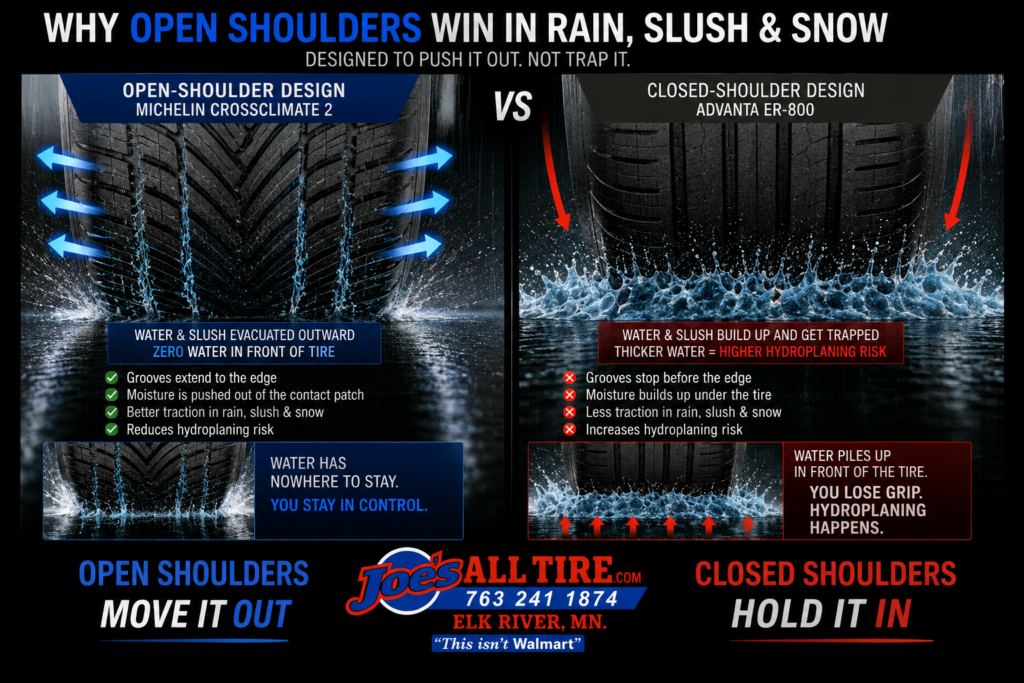
A tire can look nearly identical to another one on the rack, yet behave very differently when rain fills the ruts on Highway 10 or snow packs into a neighborhood street. Understanding closed-shoulder tires and use helps drivers choose for the conditions they actually face, not just the price tag or the treadwear number printed on the sidewall.
At Joe’s All Tire in Elk River, we see the results of tire design every season. A closed-shoulder tire can be a solid fit for certain vehicles and driving habits, especially when long tread life, quiet highway driving, and stable steering are high priorities. But for many Minnesota cars and trucks, ALL TIRE often recommends an open-shoulder design because it gives water, slush, snow, and loose material more places to go.
What Is a Closed-Shoulder Tire?
The shoulder is the outer edge of the tread, where the tire transitions toward the sidewall. On a closed-shoulder tire, that area has larger, more continuous tread blocks with fewer wide channels leading out to the edge. The design can look more solid and less aggressively cut than an open-shoulder tire.
That solid outer edge supports the tread during turns. It can help the tire feel planted on dry pavement, reduce tread squirm, and promote even wear when the vehicle is aligned and maintained properly. Many highway-oriented passenger tires, touring tires, and some performance tires use a more closed shoulder for those reasons.
An open-shoulder tire has more void space and channels around the outer tread. Those openings are designed to move water away from the contact patch and give snow, slush, dirt, and gravel somewhere to escape. Neither layout is automatically right or wrong. The better choice depends on the tire’s full design and where you drive.
Closed-Shoulder Tires and Use in Daily Driving
For a commuter who spends most of the week on dry, maintained roads, a closed-shoulder design may offer a calm, controlled ride. The continuous tread edge can make lane changes and sweeping highway curves feel more stable. On some vehicles, it can also help keep road noise down.
Closed shoulders are often useful when a driver values these traits:
- Predictable dry-road cornering and steering response
- A quieter, more highway-focused ride
- Stable tread blocks that can support long, even wear
- A less aggressive tread appearance for passenger vehicles
That said, a closed shoulder doesn’t tell the whole story about a tire. The rubber compound, siping, center grooves, tread depth, tire pressure, vehicle alignment, and load rating all matter. A well-designed closed-shoulder all-season tire may handle rain better than a poorly designed open-shoulder tire. But when conditions get wet, slushy, or snowy, the amount of room available to evacuate material becomes a major advantage.
Minnesota gives us roughly five months of snow and ice in a typical year. That changes the conversation. A tire that feels excellent on dry July pavement may not inspire the same confidence during a March thaw, when standing water, slush, and refreezing temperatures can all show up on the same drive.
Why ALL TIRE Often Recommends Open Shoulders
For cars, light trucks, and SUVs driven through Minnesota weather, open-shoulder tires are usually the more practical all-around choice. The channels at the tread edge can help water exit instead of collecting beneath the tire. That matters in heavy summer rain just as much as it matters in slush.
Open shoulders can also improve traction when snow fills the tread. As the tire rotates, the open areas provide a path for packed snow to release. A tire that sheds material more effectively has a better chance of finding grip on the surface below.
This doesn’t mean every open-shoulder tire is a winter tire, and it doesn’t mean every closed-shoulder tire is unsafe. A true winter tire uses a cold-weather rubber compound and heavy siping designed for low temperatures, ice, and snow. An M&S marking means the tire meets a tread-design standard, but it is not the same thing as severe-snow-service certification.
For many local drivers, the right answer is an open-shoulder all-weather or all-season tire with strong wet traction, appropriate load capacity, and a tread pattern that matches how the vehicle is used. For drivers who regularly travel before roads are plowed, dedicated winter tires can be the safer choice.
The Trade-Off: Road Manners Versus Evacuation
Tire choices always involve trade-offs. A more closed tread shoulder can feel crisp and steady on dry pavement, while a more open design may create a little more road noise or have a more rugged feel. The difference varies by tire model and vehicle, so it isn’t something to judge from one feature alone.
Pickup owners should pay especially close attention. A truck used mainly for commuting may do well with a highway-focused tire, but a truck that pulls a trailer, drives gravel, enters job sites, or travels unplowed roads needs more traction flexibility. The same goes for SUVs that carry families through changing weather all year.
This is where honest advice matters. Buying the lowest-priced tire without considering wet traction, load rating, and tread design can cost more later in poor performance, fast wear, or a ride you don’t enjoy. As we say at ALL TIRE, This Isn’t Walmart. The goal isn’t to push the cheapest option out the door. It’s to install tires that fit the vehicle, the budget, and the way you actually drive.
If you’re comparing tread styles and aren’t sure what makes sense for your vehicle, Joe at ALL TIRE can help narrow it down without the sales pressure. Mobile visitors can tap the blue call button in the lower left corner to ask questions or schedule an appointment.
Don’t Judge a Tire by Shoulder Design Alone
A tire’s shoulder is a useful clue, but it is only one part of the picture. Before choosing a set, look at the complete tread pattern and the tire’s ratings. Wide circumferential grooves help move water. Sipes add biting edges. The compound affects grip in hot, cold, wet, and dry conditions. Proper inflation and alignment determine whether the tread can do its job evenly.
Tread depth deserves attention, too. Even a good open-shoulder tire loses wet and snow performance as it wears down. The deeper channels that once moved water and slush gradually become shallower. If your tires are getting close to replacement, don’t wait for the first major snowstorm to find out they no longer have enough traction.
Vibration, uneven wear, pulling, and a steering wheel that won’t stay centered can also change how a tire performs. Sometimes the issue is the tire. Other times, it is alignment, balance, a worn wheel bearing, or another mechanical problem. Looking at the full vehicle prevents replacing tires without addressing the reason they wore poorly in the first place.
A Practical Way to Choose
Start with your real driving pattern. Think about where the vehicle goes during the worst weather, not just where it goes on a perfect afternoon. A daily commuter on plowed roads has different needs than a contractor’s pickup or a family SUV that regularly travels rural routes.
Then consider how long you expect to keep the vehicle, whether you tow or haul, and whether quiet ride quality matters more than extra all-weather flexibility. Bring those details to the shop. They tell us far more than simply asking for “a tire in this size.”
At ALL TIRE, the recommendation should make sense when it is explained in plain language. You’ll know whether a closed-shoulder tire fits your needs, why an open-shoulder option may be safer for your routes, and what you are paying for before the work starts.
Frequently Asked Questions
Are closed-shoulder tires good for rain?
They can be, especially when the tire also has effective center grooves and a strong wet-grip compound. Still, open shoulders generally provide more direct routes for water to leave the tread, which can be helpful in heavy rain and standing water.
Are open-shoulder tires better in snow?
Often, yes. The added void space can help clear snow and slush from the tread. For frequent winter driving, however, the tire compound and winter-specific siping matter just as much as shoulder design.
Will closed-shoulder tires last longer?
They can wear very well because their tread blocks are supported and stable. Actual tire life depends heavily on alignment, inflation, rotation intervals, driving habits, and the tire model itself.
Should my pickup have open-shoulder tires?
If your pickup sees rain, snow, gravel, job sites, towing, or rural roads, open shoulders are often a smart choice. A highway-focused closed-shoulder tire may still be appropriate for a truck used mostly on dry pavement.
Can ALL TIRE help me choose between tread designs?
Yes. Bring in the vehicle or call with your tire size, driving habits, and budget. We can explain the options clearly and recommend a tire that makes sense for Minnesota roads and your everyday use.
The tire that looks best on a showroom floor isn’t always the one that will take care of you in a downpour or on a snow-covered morning. Choose the tread design for the roads ahead, and you’ll feel the difference every time the weather turns.
