

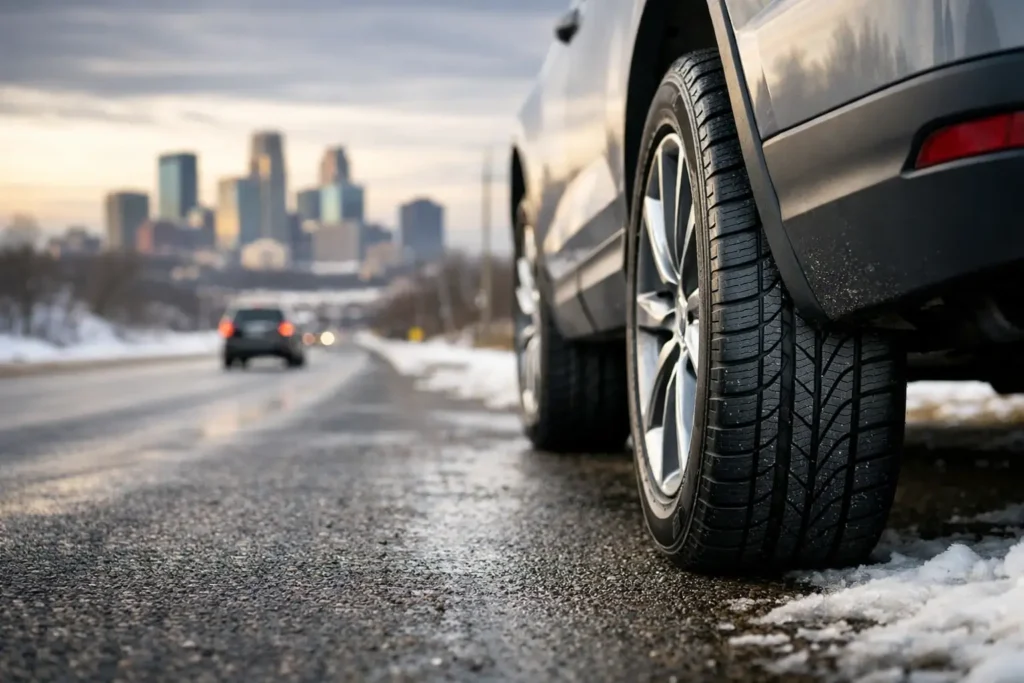
If your car gets you to work, school, daycare pickup, and everything in between, your tires are doing more than rolling down the road. Choosing the best tires for daily commuting means finding something quiet, predictable, long-wearing, and dependable when Minnesota roads turn wet, icy, or packed with slush. That last part matters more here than it does in warmer states.
A lot of drivers assume commuting tires are all the same if the size matches and the price looks decent. They are not. Some ride smoothly but give up winter grip. Some wear like iron but get loud halfway through their life. Some look good on paper and still feel unsettled on rough county roads or freeway grooves. The right pick depends on what your commute actually looks like.
What makes the best tires for daily commuting?
For most commuters, the job is simple. You want stable handling, short stopping distances, solid wet traction, low road noise, and even treadwear. You also want a tire that does not leave you second-guessing every bridge deck and intersection from November through March.
That is why the best commuting tire is usually not the cheapest tire on the rack. Budget tires can make sense in some situations, especially on an older vehicle, but they often give up the very qualities daily drivers notice most – braking confidence, ride quality, and wet-weather control. A tire can be affordable without being bottom-of-the-barrel. That distinction matters.
In Minnesota, tread design deserves extra attention. Open shoulder tires are worth talking about because they help move slush, water, and loose snow out of the tread more effectively. For cars and light trucks that stay on the road all winter, we strongly recommend open shoulder tire designs whenever they fit the vehicle and driving habits. They can make a real difference in winter traction, especially during the five months of snow and ice we deal with here.
If you want a better feel for how tread design affects real-world driving, our tire knowledge center breaks down the basics in plain language.
All-season or all-weather for a daily commuter?
This is where a lot of people get tripped up.
All-season tires are the default choice for commuting because they balance comfort, tread life, fuel economy, and year-round usability. For many drivers, they do the job well. But the name can be misleading. An all-season tire is not automatically strong in severe winter weather. Some are decent in light snow. Some are just passable.
All-weather tires are different. They are built to stay more capable in cold temperatures and winter conditions while still being usable year-round. If your commute starts early, ends late, or includes untreated side roads, an all-weather tire is often the smarter choice. You may give up a little tread life or a little fuel economy compared to a long-wearing all-season, but you gain winter confidence.
For a lot of Minnesota commuters, that trade-off is worth it.
The tire features that matter most on a workday commute
The best commuting tire is usually the one that feels boring in the best possible way. It tracks straight, stops well, and does not call attention to itself.
Wet grip and slush evacuation
Rain grooves, standing water, and slushy intersections are where a lot of average tires start to show their limits. A commuting tire needs strong siping and tread channels that clear water quickly. Open shoulder designs help here too, not just in winter but in heavy rain. That extra evacuation can improve control when the road surface is inconsistent.
Ride comfort and road noise
If you spend 30 minutes or more in the car each way, noise matters. Some tires start out quiet and get noticeably louder as they wear. Others stay composed for most of their life. Sidewall construction, tread pattern, and even vehicle type all affect this, so there is no one-size-fits-all answer. A tire that is quiet on a sedan may sound different on a crossover or half-ton pickup.
Predictable braking
Daily commuting puts you in traffic, construction zones, quick stops, and surprise lane changes. You want a tire with dependable braking on dry and wet pavement, not just decent straight-line traction. This is one of the biggest differences between a reputable touring tire and a low-end off-brand.
Tread life that matches your mileage
A driver putting on 8,000 miles a year has different needs than someone driving 22,000. Long treadwear warranties can be helpful, but they are not the whole story. A tire that lasts longer but feels sketchy every winter morning is not a bargain. Good value means usable performance for the full life of the tire.
Best tire types for different commuting habits
The phrase best tires for daily commuting sounds simple, but your answer depends on your vehicle and route.
For highway commuters
If most of your miles are freeway miles, look for a premium touring all-season or all-weather tire. These tend to offer the best mix of low noise, straight-line stability, and long wear. They also hold up better against the cupping and irregular wear that can make a commute noisy and annoying.
For mixed city and county-road driving
This is where versatility matters most. You may deal with potholes, patched pavement, gravel shoulders, and snow-packed side streets all in the same week. A tire with a durable casing, good wet traction, and an open shoulder pattern often makes the most sense.
For commuters driving crossovers and light trucks
A lot of truck and SUV owners buy more aggressive tires than they actually need. The look is one thing, but aggressive all-terrain tires can add noise, reduce fuel economy, and make the ride harsher. If your truck is mainly a commuter with occasional weekend hauling, a highway terrain or road-focused all-weather tire is often the better fit. You still get dependable traction without paying the daily comfort penalty.
Tire brands and models matter, but fit matters more
People often come in asking for the one best tire. There usually is not one universal answer.
Well-known lines from Michelin, Bridgestone, Continental, Goodyear, General, Hankook, Nokian, Toyo, Cooper, and other proven brands can all be strong options depending on the vehicle. The better question is which model fits your commute, your budget, and your expectations. A tire that works great for a Honda Accord commuter may not be the right call for a Subaru SUV or a Ford F-150.
This is also where honest advice matters. A daily driver does not always need the most expensive tire in the building. But it does need the right category and a quality level that matches the safety demands of year-round commuting.
Why installation matters as much as the tire itself
A good tire installed poorly will still ride poorly.
Mounting, balancing, inflation, torque specs, and alignment checks all affect how a commuting tire performs. If your steering wheel shakes at 65 mph or the tire starts feathering after a few thousand miles, the issue may not be the tire model at all. It may be balance, worn suspension parts, improper inflation, or alignment angles that were never corrected.
That is one reason local drivers often prefer an owner-led shop over a volume chain. You are more likely to get a recommendation based on how you actually drive, along with the kind of careful installation work that keeps a new set of tires feeling right.
When a used tire is and is not a smart commuter choice
Used tires can make sense when you need a safe, temporary solution or when the vehicle itself does not justify a full premium set. But for a high-mileage commuter, used tires are usually a short-term answer. You have less tread life left, less certainty about wear history, and less margin when roads get bad.
If your daily commute includes freeway speeds, winter driving, or family hauling, that extra margin matters. Saving money upfront can cost more later if the tire wears out early or does not perform when conditions turn ugly.
How to know it is time to replace your commuting tires
Do not wait for cords or obvious failure. If tread depth is getting low, braking distances are growing, hydroplaning is more common, or the vehicle feels nervous in light snow, your tires are already talking to you. Uneven wear, vibration, and repeated pressure loss are also signs to get them checked.
For many drivers, the biggest mistake is waiting until the first real snowfall to think about tires. By then, you are making a rushed decision instead of a smart one.
The best tires for daily commuting are the ones that match your real driving life, not a marketing label. If you commute through Minnesota weather, comfort and tread life matter, but winter traction still needs a seat at the table. A quiet tire is nice. A tire that helps you stop and steer confidently on a cold, slushy morning is better.