

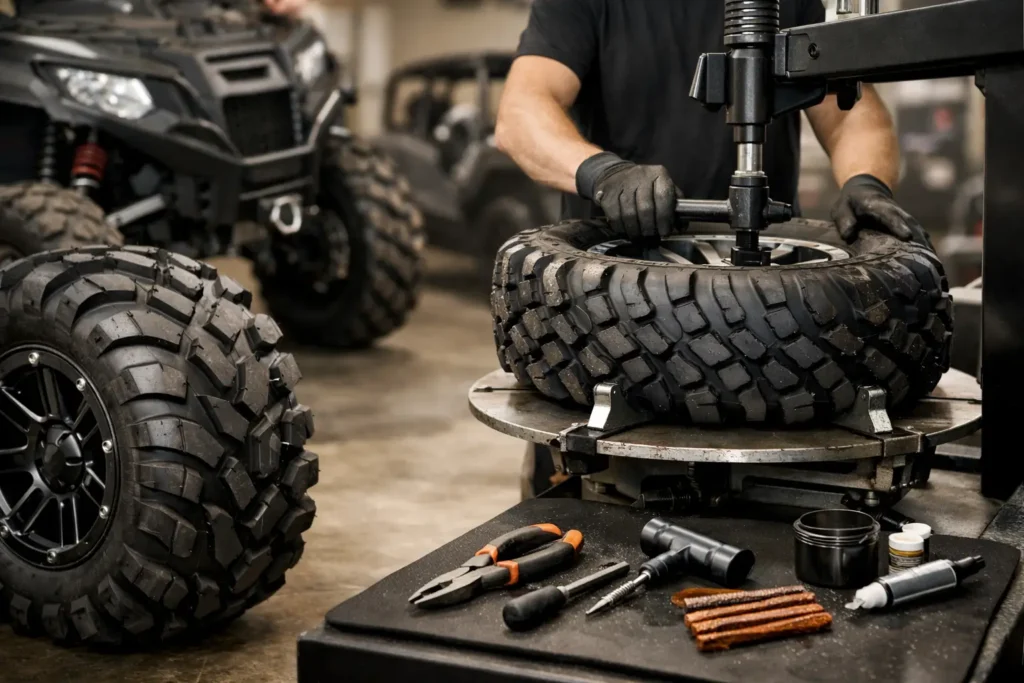
ATV & UTV Tire Mounting, Repair & Sales at All Tire
We can mount your tires or ours, and repair most ATV/UTV tires (usually) no matter where the injury.
A sidewall cut 10 miles into a trail ride usually teaches the lesson faster than any sales pitch. With ATV and UTV tires, the difference between a good day and a long tow often comes down to tire choice, proper installation/maintenance and knowing when a repair is actually safe.
ATV and UTV tires work in conditions that are harder on rubber than most passenger vehicles ever see. Rocks pinch sidewalls, roots grab tread blocks, mud packs into the lugs, and low-pressure riding puts extra stress on the bead area. That is why tire service on off-road machines should never be treated like an afterthought. The tire has to match the terrain, the mounting has to be done carefully, and any repair has to be judged honestly.
Choosing The Right ATV or UTV Tire
A lot of tire problems begin before the machine ever leaves the garage. Riders often choose a tire based on aggressive looks alone, then end up with harsh ride quality, steering issues, or tread that wears faster than expected on mixed surfaces.
If you ride mostly hard-packed trails and gravel, a tire with tighter tread spacing usually rides smoother and wears more evenly. If your machine spends more time in mud, loose dirt, and wet ground, you need larger voids between tread blocks so the tire can clean itself out. In those conditions, an open shoulder design can help at the edges of the tread where traction is often lost first. That same basic principle matters on road vehicles too, especially in a place like Minnesota where rain, slush, and snow are part of life for months at a time. If you want to learn more about how tread design affects grip, our knowledge center at www.joesalltire.com/knowledge-center/ covers that in plain English.
Tire size matters just as much as tread style. Going larger can improve ground clearance, but it can also change gearing, steering feel, and strain on suspension and driveline parts. A wider tire may add flotation in soft terrain, but it can also make steering heavier and increase rubbing if wheel offset is not right. There is no one-size-fits-all answer here. The best setup depends on how the machine is actually used.
Ply rating is another place where riders can get turned around. More ply rating generally means a tougher tire with better puncture resistance, but that does not always mean better ride comfort. A heavier, stiffer tire can be a smart choice for rocky terrain and work use. For lighter trail riding, it may feel harsher than necessary. Trade-offs are normal. Good advice starts with the terrain, the load, and the machine.
Why proper mounting matters more than most riders think
Mounting an ATV or UTV tire looks simple until a wheel gets scratched, a bead gets damaged, or the tire never seats correctly. Off-road tires can be stubborn because of their stiff sidewalls, bead design, and wheel shape. Trying to force one on with the wrong tools is a good way to create a problem that shows up later as a slow leak or vibration.
A proper mount starts with inspecting the wheel. If the rim has rust, corrosion, dents, or old sealant buildup, the bead may not seal evenly. That is especially common on machines that see water crossings, mud, or long periods of storage. The tire itself should also be checked before installation for shipping damage, bead distortion, or defects in the casing.
Lubrication matters during mounting, but it has to be the right kind and used correctly. Too little can damage the bead. Too much, or using the wrong product, can create sealing problems. Once the tire is on the wheel, bead seating needs to happen evenly. If one side hangs up or pops into place unevenly, the tire may never run true.
Then comes inflation. Off-road tires often run at lower pressures than passenger tires, but that does not mean guessing is fine. Too much pressure can make the ride harsh and reduce the contact patch. Too little can increase the chance of debeading, especially during side loads and sharp turns. The right pressure depends on tire construction, machine weight, speed, and terrain. What works in soft sand may not work at all on rocks or hard trail surfaces.
Balancing is another point riders sometimes skip. Not every off-road setup needs the same level of balance attention as a highway vehicle, but if a UTV sees higher speeds, hardpack roads, or mixed-use riding, imbalance can absolutely show up as vibration and uneven wear. Done right means paying attention to how the machine is used, not assuming every setup gets the same treatment.
When ATV and UTV tire repair is safe – and when it is not
This is where honest advice matters most. Not every flat should be repaired, and not every repair that holds air is a proper repair.
A simple tread puncture from a nail or similar object may be repairable if the injury is in a suitable area and the tire has not been run flat long enough to damage the casing. But sidewall punctures, shoulder damage, large cuts, bead injuries, and punctures in heavily flexing areas are a different story. Those tires many times need replacement, not a plug that just buys time.
Running low on air can do hidden damage even if the hole looks minor. When a tire flexes too much, the internal structure can weaken. From the outside, it may not look bad. On the trail, that weakened area can fail under load. That is why a proper repair decision is about more than plugging the visible hole.
A lot of riders carry plug kits, and there is a place for them. For emergency use to get back safely, they can be helpful. But an emergency trail fix is not the same as a trusted long-term repair. If the tire is valuable, the machine is used hard, or passengers are involved, it makes sense to have the tire inspected before assuming the problem is solved.
Leaks are not always punctures either. Bead leaks are common on older wheels, especially if mud, corrosion, or debris has built up where the tire seals. Valve stems can leak. Wheels can crack. Sometimes what looks like a bad tire is actually a wheel problem, and replacing the tire alone will not fix it.
Common signs your ATV or UTV tire setup needs attention
Most off-road tire issues give some warning before they turn into a breakdown. If the machine starts pulling to one side, the pressure may be uneven or a tire may have internal damage. If you feel a hop or wobble, you could be dealing with a bent wheel, separated tire, or poor bead seating. Repeated air loss points to a puncture, bead leak, valve problem, or wheel damage.
Uneven wear patterns tell a story too. Center wear can mean overinflation. Edge wear can point to low pressure. Chopped or irregular tread may come from terrain use, suspension issues, or an out-of-balance setup. The tire is only part of the system. Alignment, bushings, bearings, and wheel condition all affect how it wears.
If you use a UTV for work, pay close attention to load. Carrying tools, feed, firewood, or equipment changes how the tire supports weight and how much heat it builds. A tire that seems fine on light recreational rides may not hold up the same way under regular hauling.
The real value of professional ATV / UTV tires/mounting/repair
There is a reason experienced shops focus on doing tire work correctly the first time. A good service approach is not about selling the most expensive tire or pushing replacement when a repair is possible. It is about matching the tire to the machine, the terrain, and the rider, then making sure the wheel, bead, pressure, and repair decision all make sense together.
That owner-led, straight-answer mindset is what people still value at a local shop. If a tire is repairable, say so. If it is not safe, say that too. If the machine would be better off with a different tread style or stronger casing, explain why in plain terms. Joe at All Tire has built trust around that kind of direct recommendation on automotive tire work, and the same principle applies here: proper methods matter more than shortcuts.
For riders, that usually means fewer repeat leaks, better traction, less uneven wear, and less money wasted on the wrong setup. It also means less guesswork when a machine starts acting differently. Tire problems rarely stay isolated for long. A bad mount, a hidden leak, or the wrong pressure can affect handling, ride quality, and safety faster than people expect.
The best off-road tire setup is not the one with the boldest tread or the biggest size on the sidewall. It is the one that fits the machine, holds up to the terrain, and has been mounted and inspected by someone willing to tell you the truth. That kind of advice is usually cheaper than learning the hard way halfway through a ride.
