

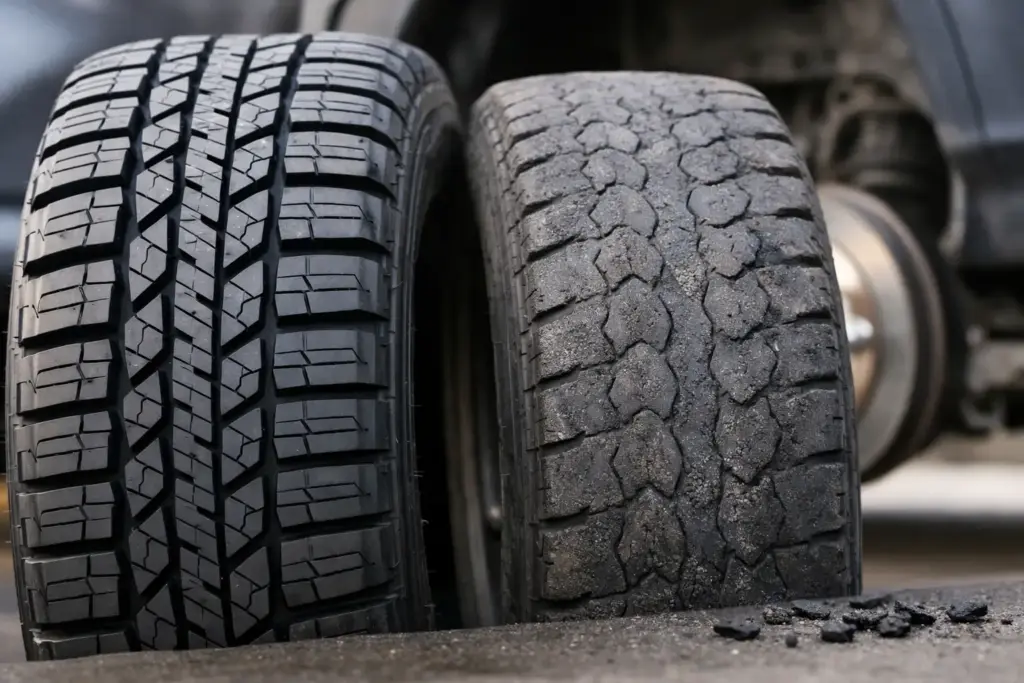
A tire can be built tough enough for a loaded work truck, but that doesn’t automatically make it the right tire for a family SUV, commuter car, or lightly used pickup. That’s why too much ply rating is bad for tire wear and cupping in certain situations: the tire may be too stiff to ride, flex, and hold the road the way your vehicle was designed to handle.
The key word is can. An overly high ply rating doesn’t directly cause every case of cupping, and it isn’t automatically a mistake. But when the tire’s load range, inflation pressure, suspension condition, and vehicle use don’t match, irregular wear can show up fast. The real job is choosing a tire that fits how you drive – not simply buying the toughest one on the rack.
What Ply Rating Actually Means
Modern “ply rating” is mostly a strength and load-capacity classification. It does not mean a tire literally contains the same number of fabric layers named on the sidewall. You may also see the term “load range,” such as Standard Load, XL, C, D, or E.
A higher load range generally means a stronger casing, higher allowable inflation pressure, and more carrying capacity. That’s useful when a truck regularly hauls equipment, tows a heavy trailer, or carries substantial payload. It can be unnecessary when that same truck spends nearly all of its time empty on Elk River roads.
For example, moving from a passenger-rated tire to a Load Range E tire can make sense for a heavily worked three-quarter-ton truck. Putting that same tire on a half-ton pickup that mostly commutes, runs errands, and occasionally pulls a small trailer may create a firmer ride and less forgiving contact with the road.
If you’re comparing tire options and aren’t sure what load range your vehicle really needs, ALL TIRE can help you sort it out without guessing. Mobile visitors can tap the blue call button in the lower left corner to ask questions or schedule an appointment.
Why Too Much Ply Rating Can Affect Tire Wear and Cupping
A tire needs some controlled flex to keep its tread planted evenly across real roads. Minnesota pavement isn’t perfectly smooth, and neither are gravel driveways, expansion joints, potholes, or frost-heaved side streets. A tire with a much stiffer casing than the vehicle needs may be less able to absorb those changes.
That reduced compliance can contribute to uneven tread contact, especially if the tires are inflated near the maximum pressure printed on the sidewall rather than the pressure listed on the vehicle’s door-jamb sticker. Too much pressure in an already stiff tire often wears the center of the tread more quickly and makes the ride harsher.
Cupping, sometimes called scalloped wear, looks like a series of low and high spots around the tire. You may hear a humming, roaring, or chopping sound that gets louder as speed increases. An overly stiff, overinflated tire can make the pattern more noticeable, but it’s usually not the root cause by itself.
The Problems That Usually Cause Cupping
When ALL TIRE sees cupped tires, we look beyond ply rating first. Cupping is commonly connected to one or more of these issues:
- Weak shocks or struts that allow the tire to bounce instead of staying firmly controlled on the pavement
- Worn suspension or steering components, including ball joints, tie rods, control-arm bushings, or wheel bearings
- An out-of-balance tire and wheel assembly
- Alignment angles that are out of specification
- Skipped tire rotations or a rotation pattern that doesn’t match the tire type
- Tires run consistently too high or too low on air pressure
A higher ply rating may amplify the symptoms because the tire is less forgiving, but replacing tires without checking the vehicle can leave you with the same wear pattern on the next set. That’s money wasted and a safety problem left unresolved.
Stiff Tires Aren’t Always the Wrong Tires
There are times when a higher load range is exactly what a vehicle needs. If you have a work truck that carries tools every day, regularly pulls a heavy camper, or hauls a trailer through Zimmerman, Big Lake, and beyond, extra casing strength can provide better stability and durability under load.
The mistake is buying based only on the idea that more ply rating always equals a better tire. More isn’t always better. It’s better only when the vehicle’s actual weight, towing needs, wheel specifications, and manufacturer requirements support it.
There can also be fitment limits. A higher load-range tire may weigh more, affect ride quality, and change how the vehicle responds to bumps. It may require different recommended pressures than your previous tire. On some vehicles, choosing the wrong load range can also make it harder to get the tire to wear evenly over its full tread life.
Tire Pressure Matters More Than the Sidewall Maximum
One of the most common misunderstandings is treating the maximum PSI on the tire sidewall as the pressure you should use every day. That number is usually the maximum pressure needed to support the tire’s maximum rated load. It is not the default setting for your vehicle.
For normal driving, start with the cold tire pressure listed on the sticker inside the driver’s door or in the owner’s manual. That recommendation is based on your vehicle’s weight distribution, original tire size, and intended use. If you’re carrying an unusually heavy load or towing, the proper pressure may change – but it should change based on the vehicle and tire manufacturer guidance, not a guess.
Overinflation can wear the center of the tread. Underinflation can wear the shoulders, build heat, and make handling less stable. Either condition can make an existing suspension, alignment, or balance issue show itself more aggressively.
Tread Design Still Makes a Big Difference in Minnesota
Ply rating is only one part of the tire decision. Tread pattern has a major effect on how a tire handles standing water, slush, packed snow, and loose material. At Joe’s All Tire, known locally as ALL TIRE, we often recommend open shoulder tire designs for cars and trucks when the fit is right.
Open shoulder designs have channels around the outer tread that help move water and slush away from the contact patch. That matters during heavy summer rain, and it matters even more during Minnesota’s long stretch of snow and ice. A well-designed open shoulder tire can give you better wet traction and stronger bite in winter conditions than a more closed, highway-focused design.
That doesn’t mean every open shoulder tire is the same, or that every aggressive-looking tire is right for daily driving. The right choice still depends on your vehicle, mileage, road conditions, towing needs, noise tolerance, and whether you need an M&S-rated tire. A proper match should deliver safe traction without creating an unnecessarily rough ride or premature wear.
How to Prevent Cupping Before It Ruins a Set of Tires
The best prevention is regular inspection, not waiting until the tire starts making noise. Run your hand lightly over the tread blocks. If they feel stepped, feathered, or uneven from one block to the next, have the tires checked soon.
Keep pressure set correctly, rotate tires on schedule, and don’t ignore steering-wheel vibration or a vehicle that wanders. If the vehicle bounces excessively after a bump, clunks over rough pavement, or has uneven tire wear, schedule a suspension and alignment inspection before buying replacement tires.
At ALL TIRE, we look at the whole picture: tire condition, balance, wheel runout, suspension movement, bearings, and alignment clues. This Isn’t Walmart. The goal isn’t to sell the highest-rated tire available. It’s to recommend the tire and repair work that make sense for your vehicle, your budget, and the way you actually use it.
FAQ
Does a higher ply rating always cause tire cupping?
No. Higher ply rating alone does not cause cupping. Cupping is more often caused by worn shocks or struts, balance issues, alignment problems, loose suspension parts, or missed rotations. A tire that is overly stiff or overinflated can make the condition worse.
Is Load Range E too much for a half-ton pickup?
Sometimes. It can be appropriate if the truck regularly carries heavy payloads or tows substantial weight. For an empty daily-driven half-ton, it may create a rougher ride and may not provide any real benefit. Check the vehicle’s tire placard and discuss your actual use before changing load ranges.
Should I inflate my tires to the maximum PSI on the sidewall?
Usually, no. Use the cold pressure listed on your vehicle’s door-jamb sticker for normal driving. The maximum sidewall PSI is tied to the tire’s maximum load capacity, not necessarily the correct everyday pressure for your vehicle.
Can rotating tires stop cupping?
Rotation can help prevent uneven wear from getting worse, but it won’t fix the cause of cupping. If shocks, struts, alignment, balance, or suspension parts are the issue, those problems need to be corrected first.
Are open shoulder tires good for Minnesota driving?
They can be an excellent choice. Open shoulder designs help clear water, slush, and loose snow from the tread, improving summer rain performance and winter traction. The exact tire should still match your vehicle, load needs, and driving habits.
A tire should work with your vehicle, not fight it. If the tread is getting noisy, cupped, or worn in strange patterns, getting it checked early can often save the tires you have and help the next set last the way it should.
