
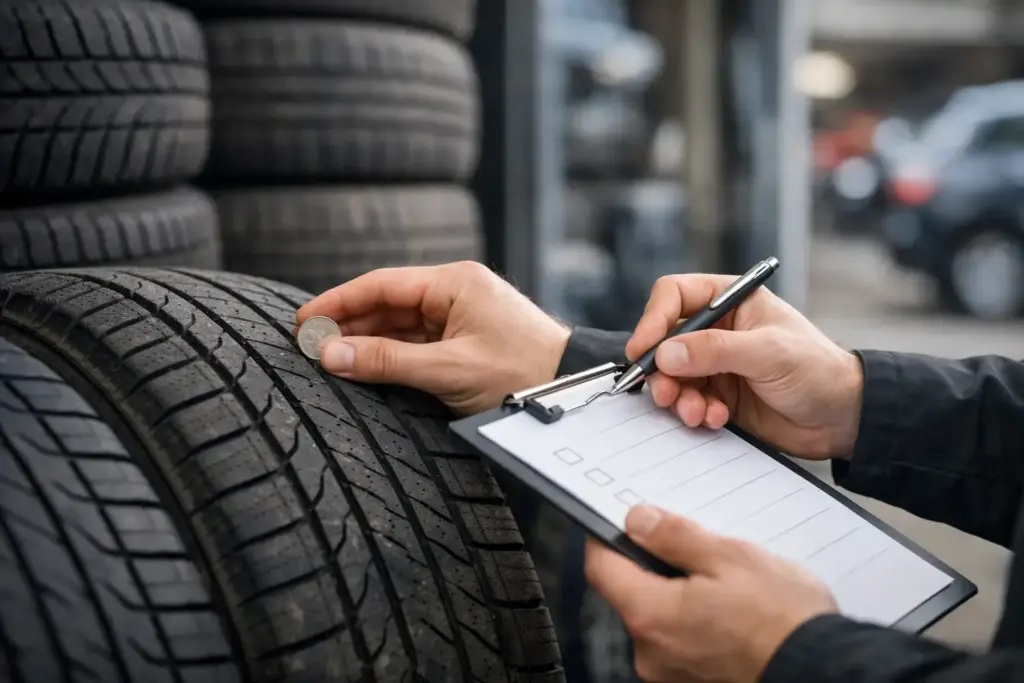
A used tire can be a smart way to solve an immediate problem, especially when you need one matching tire or a dependable option on a tight budget. But a low price means nothing if the tire is too old, unevenly worn, or damaged where you can’t see it. This used tire inspection checklist helps Elk River-area drivers look past the surface before money changes hands.
At Joe’s ALL TIRE, we see the results when a tire decision is made too quickly: vibration, poor wet-road grip, TPMS warnings, and tires that simply don’t hold up. A used tire has to be the right size, in safe condition, and suitable for how you drive. Anything less is not a bargain.
Start With the Right Tire for Your Vehicle
Before inspecting tread or sidewalls, confirm that the tire actually belongs on your vehicle. Check the size printed on your current tire or on the driver’s door placard. Numbers such as 225/65R17 describe the tire’s width, sidewall profile, construction, and wheel diameter. A tire that physically fits the wheel may still be the wrong load rating, speed rating, or overall diameter for your vehicle.
For all-wheel-drive and four-wheel-drive vehicles, matching matters even more. A single replacement tire that differs too much in tread depth or rolling diameter can put added stress on the drivetrain. It depends on the vehicle manufacturer’s tolerance, but this is not something to guess at in a parking lot.
If you’ve found a tire and aren’t sure whether it matches safely, bring the details to ALL TIRE before you buy it. We can help you sort out the practical answer fast. Mobile visitors can tap the blue call button in the lower left corner to ask questions or schedule an appointment.
Used Tire Inspection Checklist: Tread First
Tread depth is the most obvious checkpoint, but it shouldn’t be the only one. New passenger tires commonly begin around 10/32 of an inch of tread. At 2/32, a tire is legally worn out in many situations, but Minnesota drivers shouldn’t treat legal minimum as a safety target. Rain, slush, snow, and ice demand more tread to clear water and maintain traction.
For a used tire, look for tread that is deep enough to provide meaningful service, not just enough to get through a few months. Check several spots across the tire – the inner edge, center, and outer edge. A tire can look decent from one angle while being badly worn on the inside shoulder.
Watch for these wear patterns:
- Center wear can point to chronic overinflation.
- Wear on both outer edges often suggests underinflation.
- One-sided wear may indicate alignment, suspension, or wheel-bearing trouble.
- Cupping or scalloped dips can be tied to worn shocks, struts, balance issues, or loose steering and suspension parts.
- Feathered tread blocks can signal an alignment problem.
Uneven wear doesn’t automatically make a used tire unusable, but it does change the conversation. The remaining tread needs to be measured honestly, and the tire should not be paired carelessly with a much newer tire on an AWD vehicle.
Look Closely at the Shoulders
The shoulder is where a lot of tire problems hide. Run your hand carefully around both sides and look for cracking, worn-through edges, chunks missing from tread blocks, or bulges. The inner shoulder deserves special attention because it’s easy to miss while the tire is mounted on a vehicle.
Tire design matters here, too. For Minnesota cars and trucks, ALL TIRE strongly recommends open shoulder tire designs when the application allows. Open shoulder channels help move water, slush, and loose snow away from the contact patch, improving summer rain performance and winter traction. A tire with lots of remaining tread but a closed, packed-up shoulder pattern may not be the right choice for a driver facing nearly five months of snow and ice.
M&S markings can indicate a tire meets a basic Mud & Snow classification, but that label alone doesn’t tell the whole story. Tread depth, rubber condition, and the actual pattern all affect how it behaves on wet and winter roads.
Check the Tire’s Age, Not Just Its Appearance
Every tire has a DOT date code stamped on its sidewall. The final four digits show the week and year it was made. For example, 1823 means the tire was built in the 18th week of 2023.
Age matters because rubber changes over time, even when tread remains. Sun, heat, storage conditions, and long periods of sitting can dry the rubber and weaken the tire internally. A tire that looks nearly new but was made many years ago may not be a good candidate for regular driving, especially on a family vehicle, highway commuter, or loaded pickup.
There isn’t one magic age number that fits every tire. Storage conditions and use history matter. Still, a used tire with an old DOT code should raise questions, and visible dry cracking should end the discussion. Check between tread blocks, around the bead area, and along both sidewalls for fine cracks or deeper splits.
Inspect Sidewalls, Beads, and Internal Condition
Sidewall damage is one of the biggest deal-breakers. Don’t buy a used tire with a bubble, bulge, deep cut, exposed cords, or a sidewall that has been scraped hard enough to remove rubber. A sidewall bulge can mean the internal cords have been damaged by a pothole or curb strike. It may hold air today, but it’s not something to trust at highway speed.
Also inspect the bead, which is the edge that seals against the wheel. Torn rubber, heavy corrosion residue, or deformation can make mounting and air retention difficult. A tire that was improperly removed from a wheel can be damaged around this area.
Ask whether the tire has had prior repairs and where they were made. The location and quality of any repair matter. If a repair is questionable, if there are multiple repair areas, or if there is evidence of a run-flat event, it’s usually wiser to pass. A tire driven while low on air can suffer internal damage that isn’t visible from the outside.
Make Sure It Will Match What’s Already on the Vehicle
Buying one used tire is often practical when one tire was damaged and the others are still in good shape. The replacement should be the same size and ideally the same model or a close match in construction, tread pattern, and remaining depth. Mixing dramatically different patterns can change handling and wet traction.
For a two-wheel-drive vehicle, the pair on the same axle should be compatible. For AWD, the acceptable difference can be much tighter. That’s why Joe at ALL TIRE measures rather than assumes. We’ll tell you when a used tire is a sensible fix and when it could create a more expensive problem down the road.
The same goes for trailers and light trucks. Load range, inflation requirements, and tire capacity are not optional details. A passenger-car tire may not be appropriate for a loaded trailer simply because the size appears close.
Don’t Skip Installation, Balance, and the Vehicle Check
A sound used tire still needs correct installation. The wheel should be inspected for bends, cracks, and corrosion that can cause leaks. The tire should be mounted correctly, balanced, inflated to the vehicle specification, and checked for TPMS concerns where applicable.
If your old tire wore unevenly, replacing it without addressing the cause can ruin the replacement early. Alignment angles, worn suspension parts, vibration, brake drag, and wheel-bearing issues can all affect tire life. This Isn’t Walmart – the right answer isn’t always grabbing the cheapest tire and sending it down the road. It’s making sure the tire, wheel, and vehicle are working together.
When a Used Tire Makes Sense
Used tires are most useful when the goal is specific and realistic: replacing one damaged tire, getting safely through an emergency, or extending the life of a vehicle that doesn’t justify a full new set. They’re less attractive when you need maximum winter confidence, drive long highway miles, tow regularly, or need all four tires to perform consistently on an AWD vehicle.
The honest answer is sometimes a used tire, sometimes a new single tire, and sometimes a matched set. ALL TIRE carries a range of options and will explain the trade-offs plainly, without pushing a solution that doesn’t fit your vehicle or budget.
Frequently Asked Questions
How much tread should a used tire have?
More is better, but the tire should have enough even tread left to provide real service. In Minnesota, tread well above the worn-out 2/32 mark is especially valuable for rain, slush, and snow traction.
Can I put one used tire on an AWD vehicle?
Sometimes, but tread depth and overall diameter must be close enough to the other tires for your vehicle’s requirements. Have the existing tires measured before choosing a replacement.
Is a tire with sidewall cracking safe to buy?
No. Cracking can indicate aged or deteriorated rubber. Any bulge, exposed cord, deep cut, or significant sidewall damage is a reason to reject the tire.
What does the DOT date code tell me?
The last four DOT digits show when the tire was made. For example, 1823 means the 18th week of 2023. The code helps you judge the tire’s age alongside its visible condition and storage history.
Are M&S tires enough for Minnesota winter driving?
M&S is a basic Mud & Snow designation, not a guarantee of strong winter performance. For everyday Minnesota driving, adequate tread depth and an open shoulder design make a noticeable difference in rain, slush, and snow.
A used tire should leave you feeling confident when you pull back onto the road, not wondering what you missed. When the condition is unclear, let a local tire professional inspect it before a small purchase turns into a bigger repair.