
A tire sidewall can tell you a lot in a few small letters. For Minnesota drivers, understanding the criteria for mud & snow rating can mean the difference between buying a tire that handles everyday slush reasonably well and one that’s truly built for snowy, icy winter roads.
At Joe’s ALL TIRE, locals often ask whether an M+S marking means a tire is a snow tire. The honest answer is no – not necessarily. M+S is useful information, but it doesn’t prove a tire has passed a winter traction test. That distinction matters when we get months of snow, ice, cold pavement, and spring slush around Elk River.
What Does the M+S Marking Mean?
M+S stands for Mud and Snow. You may see it written as M+S, M/S, or M&S on a tire’s sidewall. It identifies a tread design that meets an industry standard for having enough open space, or void area, in the tread to help the tire move through loose surfaces better than a conventional highway-style tread.
The basic criteria for mud & snow rating focus on tread geometry, not a measured snow-driving performance test. In simple terms, the tire must have a qualifying ratio of open void area to solid tread area. That open space gives mud, slush, water, and loose snow somewhere to go instead of packing solidly into the tread.
Many all-season tires, all-terrain tires, crossover tires, and light-truck tires carry an M+S marking. It’s common because these tires are designed to be more versatile than a smooth, ribbed summer tire. Still, the M+S stamp alone doesn’t tell you how well the rubber stays flexible in deep cold or how confidently the tire will brake on packed snow.
Why Open Shoulder Tires Matter in Minnesota
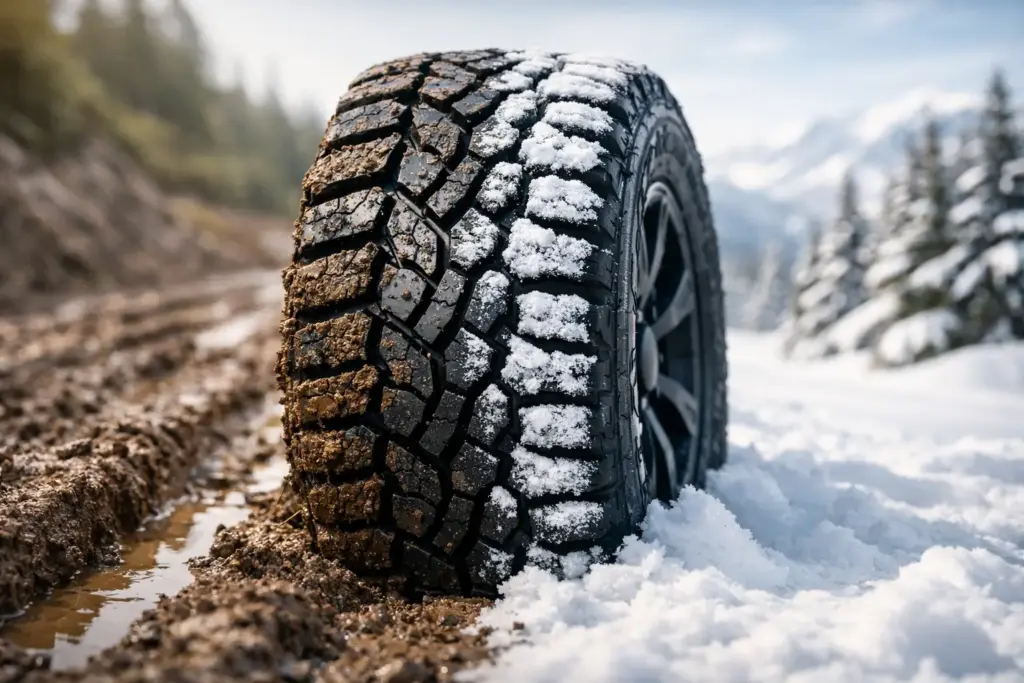
Tread shoulders are the outer edges of the tread where the tire meets the road while cornering and moving through water or slush. An open shoulder design has wider channels and more space near those outside edges. That design helps give water, slush, and loose snow a path out from under the tire.
For cars and trucks in central Minnesota, ALL TIRE strongly recommends considering open shoulder tires whenever they fit the vehicle and driving habits. They’re a practical choice for improving summer rain evacuation while also helping winter traction in slush and light snow. Minnesota gets roughly five months of snow and ice, so a tread that clears itself well is more than a marketing feature.
An open shoulder doesn’t automatically make a tire a dedicated winter tire, and it won’t overcome worn tread or overly aggressive driving. But it can be a meaningful advantage over a more closed, highway-oriented tread pattern, especially for commuters, families, and pickup owners who drive through changing conditions.
If you’re comparing tires and the sidewall markings feel confusing, it’s worth getting a straight answer before spending money. Joe at ALL TIRE can look at your vehicle, tread needs, and normal routes and explain the trade-offs plainly. Mobile visitors can tap the blue call button in the lower left corner to ask questions or schedule an appointment.
M+S Versus the Three-Peak Mountain Snowflake
The symbol that matters most for serious winter use is the Three-Peak Mountain Snowflake, often shortened to 3PMSF. It looks like a snowflake inside a three-peaked mountain outline. Unlike M+S, this symbol means the tire model has met a defined minimum traction requirement in a standardized snow test.
That’s why an M+S all-season tire and a 3PMSF-rated all-weather or winter tire aren’t the same thing. Both may have grooves, sipes, and open areas in the tread. But the 3PMSF tire has also demonstrated a level of snow traction under test conditions.
Here’s the practical way to think about it:
- M+S tires are generally designed to handle a mix of road conditions, including light snow, slush, and wet roads.
- 3PMSF all-weather tires are designed for year-round use but have verified snow traction beyond a typical M+S tire.
- Dedicated winter tires usually provide the strongest grip in sustained cold, packed snow, and ice, though they should come off when warm-weather driving returns.
- All-terrain tires may carry M+S or 3PMSF markings, but their on-road winter behavior varies a lot by model, compound, siping, and tread design.
For someone who drives mostly plowed roads in Elk River, Otsego, Big Lake, or Zimmerman and can wait out the worst storms, a quality open-shoulder all-season tire may be the right fit. For a driver who leaves before roads are cleared, travels rural routes, hauls kids daily, or needs confidence on steep or unplowed driveways, a 3PMSF-rated option deserves serious consideration.
What the Rating Doesn’t Tell You
A sidewall symbol is one piece of the decision, not the entire decision. Two M+S tires can perform very differently because their rubber compounds, siping patterns, tread depth, casing construction, and shoulder designs are different.
Sipes are the small cuts across tread blocks. They create more biting edges that can help on snow and slick surfaces. A tire with plenty of well-designed siping and open shoulders may clear slush and find grip better than a tire that technically carries M+S but uses a less winter-focused tread pattern.
The same goes for tread depth. Even a strong tire design loses its ability to move water and snow as it wears down. Once the channels get shallow, the tire can’t evacuate slush as effectively, and stopping distances grow. Four matching tires with healthy tread give the vehicle its most predictable handling. Mixing very different tread patterns or putting two worn tires into winter service can create unpleasant surprises when roads get slick.
Vehicle type matters, too. A front-wheel-drive sedan, an all-wheel-drive crossover, and a heavy-duty pickup don’t ask the same things from a tire. All-wheel drive helps a vehicle get moving, but it does not create extra braking grip. The tire compound and tread still do the work when it’s time to stop or turn.
How to Choose Without Overbuying or Cutting Corners
The right tire isn’t always the most aggressive-looking one. Deep, blocky tread may suit a truck that sees gravel, job sites, or unplowed property, but it can bring more road noise, a firmer ride, or faster wear on pavement. A mild all-season tire may ride quietly and last well, but it may not be enough for a driver who faces frequent early-morning snowpack.
Start with how and where you actually drive. Consider your commute, whether your road gets plowed quickly, how often you travel in storms, whether you tow, and whether your vehicle is parked outside. Then look beyond the M+S letters at the entire tire design and whether it has the 3PMSF symbol.
Price matters, and nobody needs a sales pitch. But tires are where your vehicle makes contact with the road. A low upfront price can look attractive until poor wet traction, early wear, vibration, or weak winter performance costs more in the long run. This Isn’t Walmart. At ALL TIRE, the goal is to recommend a tire that fits the job, install and balance it correctly, and make sure you understand what you’re getting.
Proper air pressure is part of the picture, too. Cold weather lowers tire pressure, and low pressure can hurt handling, wear tires unevenly, and trigger the TPMS warning light. Check pressures when temperatures drop and don’t assume the number printed on the tire sidewall is your vehicle’s recommended pressure. Use the pressure listed on the driver’s door placard unless there’s a specific reason to do otherwise.
FAQs About Mud and Snow Tire Ratings
Is M+S the same as a snow tire?
No. M+S means the tire’s tread design meets criteria related to open void area. It doesn’t mean the tire has passed the standardized snow-traction testing required for the Three-Peak Mountain Snowflake symbol.
What does 3PMSF mean on a tire?
3PMSF means Three-Peak Mountain Snowflake. It shows that a tire model has met a recognized minimum snow-traction standard in testing. It’s a stronger indicator of winter capability than M+S alone.
Are all-season M+S tires good enough for Minnesota?
It depends on your driving. A quality all-season tire with open shoulders can work well for many drivers on maintained roads. If you regularly drive before plows arrive, travel rural roads, or need more winter confidence, a 3PMSF all-weather tire or dedicated winter tire may be a better choice.
Do open shoulder tires help in the rain, too?
Yes. Open shoulders help channel water away from the contact area, which can improve wet-road traction and resistance to hydroplaning. That’s one reason they’re a smart design feature for Minnesota’s rain, slush, and snow.
Can I rely on AWD with regular M+S tires in winter?
AWD helps you accelerate, but it doesn’t replace tire grip when braking or cornering. Good tread depth, a cold-weather-capable compound, and the right tire design still make the biggest difference when the road turns slick.
Before the next snowfall catches you with a worn tread or a tire that doesn’t match your driving needs, stop in and have the options explained by someone who works on these vehicles every day. A clear recommendation now can make every cold commute feel a little more controlled.