
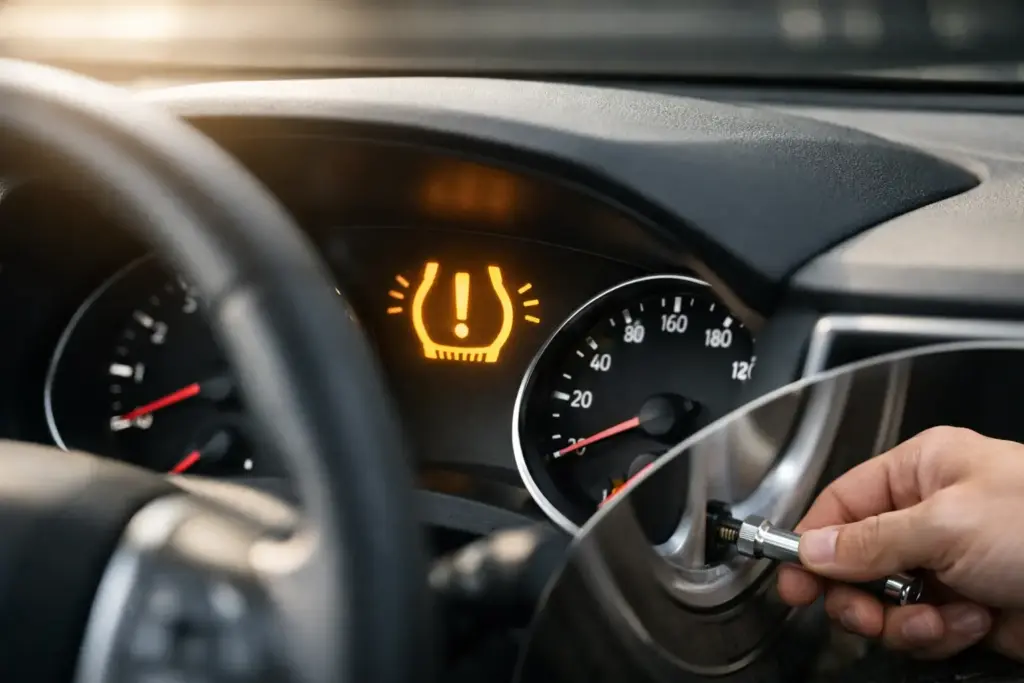
A solid TPMS warning light usually means one or more tires are low. But if you’re asking, why is my TPMS light flashing, your vehicle is trying to tell you something different. A flashing light typically points to a problem with the tire pressure monitoring system itself, not simply low air pressure.
That distinction matters, especially around Elk River, where a cold Minnesota morning can drop tire pressure fast and winter road conditions don’t leave much room for guesswork. Check your tire pressures first, but don’t assume adding air will fix a flashing TPMS light.
What a Flashing TPMS Light Usually Means
On most vehicles, the TPMS light will flash for roughly 60 to 90 seconds after startup, then stay on solid. That pattern generally means the system has detected a fault. One or more sensors may not be communicating with the vehicle, the sensor battery may be dead, or there could be an issue with the TPMS receiver or related wiring.
A solid light is usually a pressure warning. A flashing-then-solid light is usually a system warning. Your tires could be properly inflated and the flashing light may still appear because the vehicle can’t reliably read one of its sensors.
The system is helpful, but it isn’t a replacement for looking at your tires and checking pressure with a quality gauge. TPMS is designed to warn you after pressure has dropped enough to trigger the system. It doesn’t tell you whether tread is worn, a sidewall is damaged, or a tire has an unsafe internal problem.
Common Reasons Your TPMS Light Is Flashing
The most common cause is a failed sensor battery. TPMS sensors live inside the wheel and are powered by sealed batteries. Depending on the vehicle, driving habits, and sensor quality, they often last five to 10 years. Once that battery dies, the sensor must be replaced.
Other common causes include:
- A damaged sensor after a pothole strike, curb hit, or tire service
- A sensor that wasn’t properly programmed or relearned after tire work
- Corrosion or damage around the valve stem on certain sensor designs
- A missing or incompatible sensor after a wheel or tire change
- A communication problem in the vehicle’s TPMS module or receiver
If the warning began right after new tires, a rotation, a repair, or switching between summer and winter wheel sets, the relearn procedure is worth checking first. Many vehicles need to be told where each wheel is located after service. Others learn automatically after driving for a while. The correct process depends on the make and model.
First, Check Your Tire Pressure the Right Way
Even when the light is flashing, confirm the actual tire pressures before focusing only on the electronics. Tires can lose pressure because of a nail, a leaking valve stem, a bent wheel, or normal temperature changes. A TPMS fault and a low tire can happen at the same time.
Check pressure when the tires are cold, ideally before the vehicle has been driven more than a few miles. Use the pressure listed on the driver’s door-jamb label, not the maximum PSI molded into the tire sidewall. That sidewall number is not your vehicle’s recommended operating pressure.
If one tire is noticeably low, inflate it to the door-label specification and watch it closely. A tire that keeps losing air needs to be inspected. Don’t keep topping it off and hoping it holds. Slow leaks have a way of becoming roadside problems at the worst possible time.
Can You Drive With a Flashing TPMS Light?
Usually, you can drive the vehicle carefully long enough to get the issue diagnosed, provided the tires are properly inflated and there’s no visible tire damage. A flashing TPMS light doesn’t automatically mean the tire is about to fail. It does mean you may not receive a reliable low-pressure warning until the system is repaired.
That’s the real concern. You lose a safety backup that can alert you before a low tire affects handling, braking, fuel economy, or tread life. For commuters, families, and pickup owners dealing with rain, gravel roads, and five months of snow and ice, that’s not a warning worth ignoring for long.
If you notice pulling, vibration, a visibly low tire, repeated pressure loss, or a tire that looks damaged, stop driving and have it checked. Those symptoms deserve attention whether the TPMS light is on, off, flashing, or nowhere to be seen.
Why Tire Service Can Trigger a TPMS Problem
TPMS sensors are mounted inside the wheel near the valve stem. Removing and installing tires requires care around that area. A sensor can be damaged by impact, age, corrosion, or improper handling. Sometimes the sensor was already near the end of its battery life, and tire work simply makes the issue show up.
This is why proper installation matters. Mounting and balancing shouldn’t be rushed, and a warning light shouldn’t be brushed aside with “it’ll probably go away.” At Joe’s All Tire, known locally as ALL TIRE, we diagnose what the vehicle is actually reporting before recommending a repair. If a sensor needs replacement, we can identify the failed unit, install a compatible sensor, program it correctly, and verify the system is reading again.
If you’re deciding whether the light is a simple relearn issue or a failed sensor, getting a real diagnosis can save you from replacing parts you don’t need. Mobile visitors can tap the blue call button in the lower left corner to ask questions or schedule an appointment.
TPMS, Tread, and Minnesota Traction
A working TPMS system helps protect your tires, but it can’t make up for worn tread or the wrong tire design for your driving. Pressure affects how the tire contacts the road. Underinflation can make a tire run hotter, wear its shoulders, and feel less stable. Overinflation can reduce the contact patch and contribute to uneven center wear.
For Minnesota drivers, tread design also matters. ALL TIRE strongly recommends open shoulder tire designs for many cars and trucks because they help move water, slush, and snow away from the tread. That can improve wet summer-road performance and winter traction compared with more closed-up designs. The right choice still depends on your vehicle, mileage, budget, and whether you drive mostly highways, town roads, job sites, or rural routes.
A TPMS warning is a good reminder to look at the whole tire, not just the dashboard icon. Check tread depth, inspect for uneven wear, and pay attention to vibration or steering changes. A tire can have plenty of air and still be due for service.
What a Proper TPMS Diagnosis Looks Like
A proper inspection starts by verifying all four tire pressures and checking the tires for leaks or damage. Next, a technician uses a TPMS scan tool to see whether each sensor is transmitting, what pressure it reports, and whether its battery or communication status is failing.
From there, the fix might be as simple as a relearn procedure. If a sensor has failed, replacement is usually the practical answer. In some cases, especially on older vehicles, further diagnosis of the vehicle-side system may be needed.
The goal isn’t to sell sensors automatically. It’s to find the actual reason the warning is flashing and get the safety system working again. That’s honest advice, and it’s how the job gets done right the first time.
Frequently Asked Questions
Does a flashing TPMS light mean I have a flat tire?
Not necessarily. A flashing light most often indicates a TPMS system fault. Still, check every tire’s pressure immediately because a low tire and a sensor problem can occur together.
How long does a TPMS light flash before staying on?
On many vehicles, it flashes for about 60 to 90 seconds after startup and then stays illuminated. Check your owner’s manual for the exact behavior on your vehicle.
Will the TPMS light reset itself after I add air?
A solid low-pressure light may turn off after you set the tires to the correct cold pressure and drive the vehicle. A flashing light generally will not reset until the system fault is repaired or the relearn procedure is completed.
Do TPMS sensors need to be replaced with every new set of tires?
No. Sensors don’t automatically need replacement with every tire purchase. However, older sensors with weak batteries or damage may fail around the time new tires are installed, and replacing them while the tire is already off the wheel can make sense.
Is it safe to wait on a TPMS repair?
You may be able to drive temporarily if all tires are properly inflated and undamaged, but don’t put it off indefinitely. Until the system is repaired, you’ll need to check tire pressures manually and regularly. A quick inspection now can help keep a small warning from becoming a bigger safety issue later.