

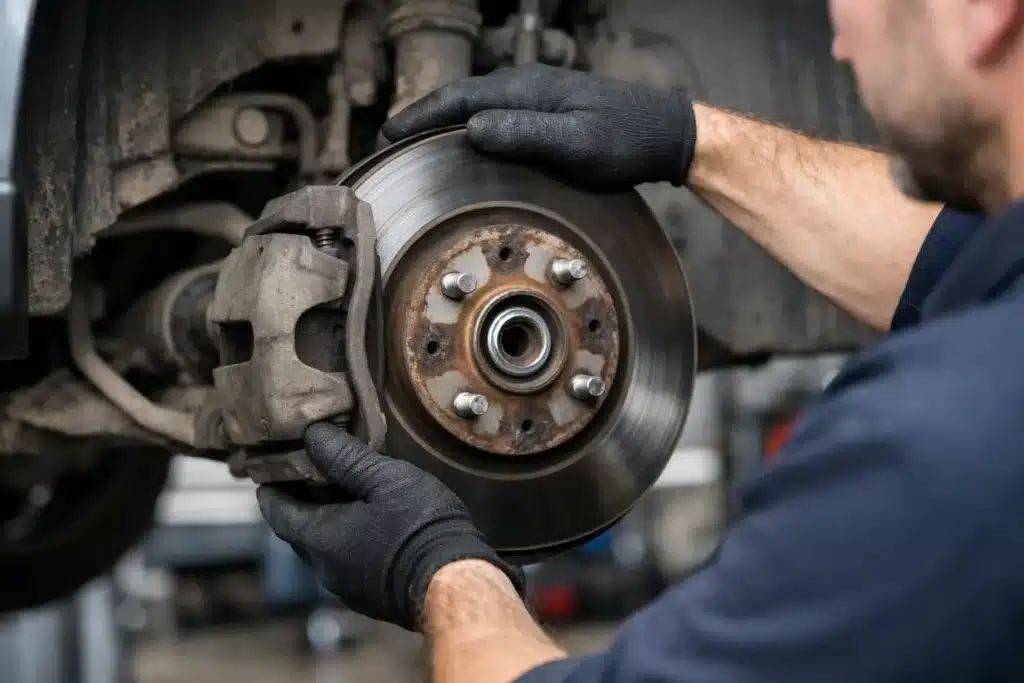
A bad wheel bearing usually doesn’t start with a dramatic failure. More often, it shows up as a low growl on the highway, a little looseness you can feel through the steering wheel, or a vibration that seems to come and go with speed. If you’re wondering how to tell wheel bearing play, the key is knowing what movement is normal, what isn’t, and when to stop guessing and have it checked.
How to Tell Wheel Bearing Play Without Guessing
Wheel bearing play means the wheel and hub have more movement than they should. That movement can be side to side, in and out, or it can show up as roughness while the wheel turns. Bearings are built to let the wheel rotate smoothly under load. When they wear, loosen, or lose lubrication, that smooth support starts to disappear.
The tricky part is that not every noise or shake is a bad wheel bearing. Tires can hum. Brakes can drag. Suspension parts can create clunks and looseness too. That’s why a quick driveway check can be useful, but it has limits. The goal isn’t to become your own shop overnight. It’s to notice the signs early enough that you don’t let a small problem turn into a bigger repair.
A simple first clue is sound. A worn wheel bearing often makes a humming, growling, or roaring noise that gets louder as speed increases. Sometimes it changes when you steer slightly left or right. For example, if the noise gets louder while turning left, the right-side bearing may be under more load and showing its wear. That’s not a perfect rule every time, but it’s common.
Another clue is feel. If your vehicle feels loose, wanders more than usual, or sends a vibration through the floor or steering wheel that isn’t tied to braking, a bearing can be part of the problem. On trucks and trailers, you may also notice uneven tire wear if the bearing has enough play to affect how the wheel tracks.
The Basic Hands-On Check
If you’re comfortable checking your vehicle, start with the wheel safely off the ground and the vehicle properly supported. Safety matters here. Never trust a jack alone.
Grab the tire at the 12 and 6 o’clock positions and try to rock it in and out. Then try the same at 3 and 9 o’clock. You’re feeling for looseness, clicking, or a noticeable clunk. A solid wheel should feel tight. A little movement doesn’t always mean the bearing is bad, because some suspension or steering parts can also create play, especially in the 3 and 9 position. But if the looseness is obvious and you can feel the hub shifting, that’s a red flag.
Now spin the wheel by hand. A healthy bearing should turn smoothly and quietly. If it feels rough, gritty, or sounds like it’s dragging over sand, that’s another warning sign. On some vehicles, brake pad contact can add a light rubbing sound, so you’re listening for harshness, not just any contact noise.
Heat can also tell you something. After a normal drive, a failing bearing may run hotter than the others. You don’t want to touch a hot hub or brake area with bare hands right away, but if one wheel area is clearly hotter than the rest, that can point to trouble. Keep in mind, though, that a sticking brake caliper can create heat too. That’s where experience matters.
If you’re not sure whether what you’re feeling is normal or not, we can help you sort it out fast. Just tap the blue phone call button in the lower left corner – we’re just a call away.
What Wheel Bearing Play Feels Like on the Road
The road test matters because some bearings won’t show obvious looseness in the air but still make noise under load. That’s especially true in earlier stages.
Most drivers describe bad bearing noise as a tire noise that doesn’t go away after rotation, or a road hum that keeps getting worse week by week. It usually rises with speed. At 20 mph it may be faint. At 50 or 60 mph it can be hard to ignore. Sometimes it sounds like aggressive tread, even when the tires aren’t the problem.
In Minnesota, where roads see potholes, frost heaves, slush, and plenty of winter abuse, front-end noises can be deceptive. Tires, bearings, brakes, and suspension all take a beating. That’s one reason we don’t like guessing. At All Tire, the point is to isolate the real cause, not throw parts at a symptom.
How to Tell Wheel Bearing Play vs. Other Problems
This is where a lot of people get tripped up. Loose wheel movement can come from more than one place.
If movement shows up mostly at 3 and 9 o’clock, tie rods or steering parts may be involved. If it shows up more at 12 and 6, that can suggest a bearing, but ball joints or suspension wear can also be in the mix. If the wheel spins rough and the noise changes with speed, that leans more toward a bearing. If the vibration happens mainly when braking, the issue may be rotor-related instead.
Tire wear can imitate a bad bearing too. Cupped or chopped tread can make a roar that sounds almost identical from inside the vehicle. That’s why tire condition always needs to be part of the diagnosis. On vehicles that need strong wet-weather and winter grip, we often recommend open shoulder tire designs because they clear water and slush better and help with traction in real Minnesota driving. But even the right tire can get noisy if it’s worn unevenly from suspension or bearing issues.
When Wheel Bearing Play Means Stop Driving
Some bearing problems are annoying but still drivable for a short time. Others need attention now. It depends on how much play there is, how rough the bearing feels, and whether the noise is getting worse quickly.
If the wheel has obvious looseness, if you hear grinding instead of humming, or if there’s ABS warning activity tied to the hub area, don’t keep putting it off. A badly worn bearing can damage the hub, affect braking, ruin a tire, or in extreme cases create a serious safety problem. That’s not scare talk. It’s just what happens when rotating parts lose the support they’re supposed to have.
Trailers deserve special attention here. Bearing issues on trailers can move from minor to major fast, especially during highway driving or heavy loads. If you tow, regular bearing inspection and repack service matter a lot more than people think.
Why Proper Diagnosis Matters
This isn’t Walmart. If someone is rushing through a noise complaint and guessing at parts, you can spend money and still have the same problem when you leave. Bearing diagnosis needs a real inspection, not a shrug and a sales pitch.
A good shop will check wheel play correctly, listen for roughness, inspect related brake and suspension components, and road test the vehicle when needed. On some vehicles, the bearing is part of a hub assembly. On others, service procedures differ. The repair has to match the design, and the torque specs have to be right. That’s where proper workmanship matters.
At Joe’s All Tire, Joe is on-site daily, and that owner-led approach makes a difference. You’re getting direct recommendations based on what the vehicle actually needs, not what pads the ticket. For something safety-related like a wheel bearing, that’s exactly how it should be.
What to Do If You Suspect Wheel Bearing Play
If the symptoms are mild, avoid long trips and get it checked soon. If the wheel feels loose, the noise is severe, or you’re getting grinding, don’t wait. The sooner you catch it, the better chance you have of preventing extra damage.
When you bring the vehicle in, be ready to describe what you noticed. Does the noise change with speed? Does it get louder while turning? Is there vibration in the steering wheel, seat, or brake pedal? Did it start after hitting a pothole or curb? Those details help narrow things down faster.
And if it turns out not to be a wheel bearing, that’s still useful. Good diagnosis saves money because it keeps you from replacing the wrong part.
A little wheel noise can be easy to ignore for a while, especially when life is busy. But if your vehicle is telling you something has changed, it’s worth listening before a small bearing issue turns into a much bigger day.
